Economics of Business 2 Spring 2024 Tutorial I
Hello, dear friend, you can consult us at any time if you have any questions, add WeChat: daixieit
Economics of Business 2
Spring 2024
Tutorial I
Initially posted on Jan. 04, 2024 (VERSION 1)
Read the following materials and answer the questions:
Problem 1*: Lecture Note 0, Train (1991) Introductory Chapter
Goal - Understanding the concept of own elasticity
Problem 2*: Lecture Note 0, Train (1991) Introductory Chapter
Goal - Understanding the profit maximization of unregulated monopolist
Understanding first- and second-best outcomes
Problem 3**: Lecture Note 0, Train (1991) Introductory Chapter
Goal - Understanding the production function and marginal cost
Problem 4**: Lecture Note 1, Train (1991) Ch.1 (Specifically, Section 1.2)
Goal - Understanding the cost-minimization of unregulated monopolist
Understanding the expansion path
Problem 5**: Lecture Note 1, Train (1991) Ch.1
Goal - Understanding the Rate of Return regulation with fixed labor
Problem 6**: Lecture Note 0, Train (1991) Introductory Chapter
Goal - Understanding the concept of consumer surplus
* Answers are provided in Tutorials.
** Online answers are provided.
Office Hours:
- Hisayuki YOSHIMOTO: Wed. 9:00-9:55am, Thu. 9:00-9:55am (during the Semester 2 teaching period, except vacation and traveling periods), Zoom on-line room (link posted on Moodle)
Note that office hours are for students who have studied materials and have some detailed/clarifying questions. Thus, office hours are not for solving prob-lems together with students or for re-explaining rudimentary concepts already addressed in the lecture but are for clarifying students’ specific/intellectual ques-tions (often with useful hints and tips to enhance students’ understandings). Questions related to tutorial problems are welcome. Use the office hours wisely to obtain better comprehension over the course materials.
Motto: Let’s get many economic insights behind equations and numbers.
Tip: Suggested to organize a student-studying group to solve and discuss prob-lems well.
1. Elasticities of Demands
Definition: Elasticity of Demand ( )
)
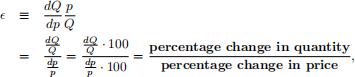
where “dQ” denotes a small change in quantity of sales and “dp” denotes a small change in price. An elasticity is unit free (you do not have to care for the money unit such as pound, pence, dollar, or cent). A demand elasticity is usually negative.
Convenient Interpretation: If the elasticity of demand is ,
1% price increase causes −% decrease in sales quantity.
1% price decrease causes −% increase in sales quantity.
Moreover, we can classify

See Footnote.
(a) If the demand is Q(p) = 20 − 2p with Q = 4 and p = 8, what is the elasticity of demand? Is the demand elastic or inelastic at (Q, P) = (4, 8)? Draw the figure.
(b) If the demand is Q(p) = 20 − 2p with Q = 16 and p = 2, what is the elasticity of demand? Is the demand elastic or inelastic at (Q, P) = (16, 2)? Draw the figure.
(c) If the demand is Q(p) = 20 − 2p with Q = 10 and p = 5, what is the elasticity of demand? Is the demand unit elastic at (Q, P) = (10, 5)? Draw the figure.
(d) If the demand is Q(p) = C · p a where C is a positive constant and a is (usually) a negative constant number, what is the elasticity of demand? (Note: we call this demand function a “constant elasticity” demand function. You will see why we call it in this way.)
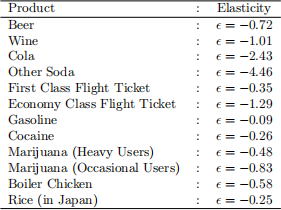
(e) Empirical studies show that elasticities of demands vary across prod-ucts as listed below. Discuss your economic insights (within 40 words).
2. Monopolistic Firm’s Profit Maximization
Somewhere in the Caribbean, there is the (fictional) Econo Kingdom Is-land. The king appointed you as a chief economic consultant to improve the island’s total surplus. On the island, there is only one cigarette firm, Smokes-A-Lot. The demand of cigarettes is Q(p) = 20−2p (quantity unit is million cigarette boxes). Also the marginal cost (MC) is constant at 2 (price unit is pound). A fixed cost is known as F = 7.5 (that is the cost of renting the land for tobacco trees, a factory, warehouse, etc. Also, unit is million pounds).
(a) Calculate the inverse demand function P(Q).
(b) Calculate Smokes-A-Lot’s marginal revenue function MR(Q).
(c) Calculate Smokes-A-Lot’s average cost function AC(Q).
(d) Draw the figure of inverse demand function, marginal cost, marginal revenue, and average cost. FYI, the average cost and demand func-tion intersects at (Q, P) = (15, 2.5).
(e) Write Smokes-A-Lot’s profit function π(Q).
(f) Calculate Smokes-A-Lot’s profit-maximizing producing quantity QM and profit-maximizing market price PM. How much is PM higher than MC?
(g) Why does the monopolist choose the quantity that satisfies MR = MC? Discuss the economic insights behind this (within 70 words).
(h) Calculate the consumer surplus (CSM) and profit πM. Then, calcu-late the total surplus (T SM).
(i) Calculate the dead-wight loss (DW L) caused by this monopolization.
(j) First-Best Optimal Outcome: With his mighty political power, the king considers to force Smokes-A-Lot to set the price to be the marginal cost. How much is the consumer surplus (CSFB) after this enforcement? How much profit (πFB) can Smokes-A-Lot earn? De-scribe what will happen to the monopolist’s profit. How much is the total surplus (T SFB)?
(k) Second-Best Optimal Outcome: As the king’s most trusted eco-nomic consultant, you suggest that the king sets the price at which the average cost curve and the demand curve intersect. How much is the consumer surplus (CSSB) after this enforcement? How much profit (πSB) can Smokes-A-Lot earn? How much is the total surplus (T SSB)? Note that surpluses and profits are measured in millions of pounds in this problem.
(l) Compare CSM, CSF B, and CSSB. Also, compare πM, πF B, and πSB. Furthermore, compare T SM, T SFB, and T SSB. Then, state your economic insights as the consultant (within 50 words).
3. Production Function and Marginal Cost
Somewhere in the Caribbean, there is the (fictional) Econo Kingdom Is-land. On the island, there is only one salt producer/manufacture, Some-Like-It-Salty that produces salt from the sea water. Some-Like-It-Salty which has the production function Q(K, L) = A · Kα · L β , where A is a production technology level (eg. technical methods for refining sea water), K is the capital (various salt-refining equipment, measured in pounds), L is labor (unit in working hours), and α and β are constant numbers. Also, on the island, the capital rental rate is r (see the footnote) and the la-bor wage is w (unit in hourly wage). In addition, Some-Like-It-Salty has a fixed cost F (eg. property insurance, factory rental fee). As his chief economic consultant, you are asked to investigate the marginal cost of Some-Like-It-Salty.
(a) Assume that Some-Like-It-Salty targets to produce the quantity  . Write the firm’s cost minimization problem with the cost function C(K, L, r, w) and a production quantity/target constraint.
(b) Given the target production quantity , solve the production func-tion equation for capital. Also, solve the production function equa-tion for labor.
(c) Substitute the answers in (b) into the cost equation, then find the cost-minimizing level of capital by taking a derivative with respect to K. Similarly, find the cost-minimizing level of labor.
(d) Substitute the cost-minimizing levels of capital and labor found in (c) into the cost equation, and derive the cost function C(, r, w).
(e) By taking the derivative of C(, r, w) with respect to , derive the marginal cost function MC(, r, w).
(f) Given the other variables fixed, what will happen to the marginal cost function MC(Q, r, w) if A increases (i.e. production-technology level enhances)?
(g) What will happen to the marginal cost function MC(, r, w) if (i) α + β > 1, (ii) α + β = 1, and (iii) α + β < 1?
(h) If A = 1, α = 2/1, and β = 2/1, how much is the marginal cost?
4. Unregulated Monopolistic Firm’s Cost Minimization Problem
On the (fictional) Econo Kingdom Island, there exists a monopolistic salt seller/producer, Some-Like-It-Salty that collect salt from the ocean and sells it to the island citizens. The production function of the firm is known as Q(K, L) = K2/1·L2/1, where K is the capital (various salt-refining equip-ment) and L is labor. Also, on the island, the capital rental rate is r and the labor wage is w.
(a) Assume that Some-Like-It-Salty targets to produce the quantity Q. Write the firm’s cost minimization problem.
(b) Assume that the firm plans to produce Q1,Q2, and Q3, where Q1 < Q2 < Q3. Draw the figure of isquant curves.
(c) Add the isocost lines.
(d) As you have seen above, a cost-minimizing firm has to choose inputs (capital and labor) so that an isoquant curve’s tangent meets (we say this is where they “kiss”) an isocost line (otherwise a firm is not min-imizing its costs). The following concept illustrates how they “kiss.”
Concept:
• To produce the same quantity Q, how much labor will the firm be able to cut after increasing its capital by a small amount?
Details
• If the firm increases its capital by a small amount (i.e. ∂K unit), it will produce  more.
more.
• If the firm cuts its labor by a small amount (i.e. −∂L unit), it will produce  less.
less.
Offsetting: Producing the same Quantity
To keep producing the same amount, the firm’s offsetting equation is

where the interpretation is

Marginal Rate of Technical Substitution:
By arranging the equation, we can define a Marginal Rate of Tech-nical Substitution (MRTS) as
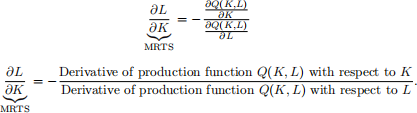
To keep producing the same quantity means that the firm chooses inputs (capital and labor) on an isoquant curve. Now, we can under-stand how they “kiss.” That is, a MRTS is equal to the slope of an isocost line.
Cost Minimizing Condition:
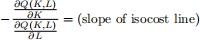
Cost minimization occurs when an isoquant curve’s tangent (i.e. MRTS) meets an isocost line, that is
MRTS = (slope of isocost line).
Equivalently,
Derive the Some-Like-It-Salty’s expansion path.
(e) How doese the expansion path change if the wage on Econo Kingdom Island rises? Draw the figure.
(f) Given the target production quantity  , calculate the optimal input choices of capital (K∗
) and labor (L
∗
).
, calculate the optimal input choices of capital (K∗
) and labor (L
∗
).
(g) What will happen if the rental rate of capital r becomes higher on the island? Does Some-Like-It-Salty use more capital? Does the amount of labor increase?
2025-08-15