Quality Management for Process Improvement
Hello, dear friend, you can consult us at any time if you have any questions, add WeChat: daixieit
Question 1
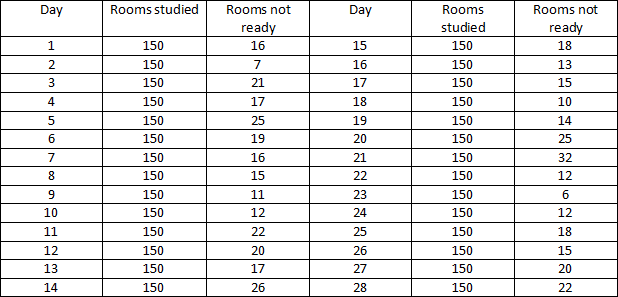
You are the ABC Hotel manager. You want to study the process of room readiness, subgroups of 200 rooms were selected daily for a four-week period. For each room in the sample, it was determined whether the room contained any nonconformances in terms of the availability of amenities and the working order of all appliances upon check-in. The following table lists the number and proportion of nonconforming rooms (please estimate on your own) for each data in the four-week period.
a. Test the assumptions of using the control charts and check if using the selected chart is valid.
b. Is the service process in control (you must substantiate your arguments with evidences generated from Minitab)?
c. What would be the next action you propose to undertake?
Question 2
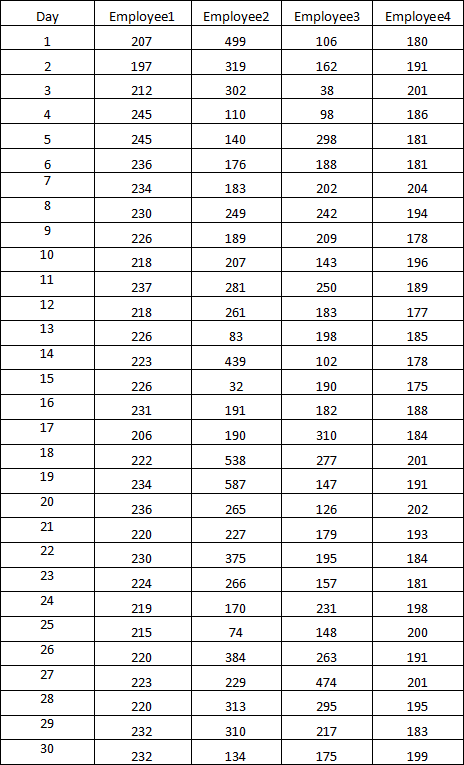
The manager of a warehouse for a local telephone company is involved in a process that receives expensive circuits boards and returns them to central stock so that they can be used a later date when a circuit or new telephone service is needed. The timely return and processing of these units is critical in providing good service to field customers and reducing capital expenditures of the corporation. The following table represents the number of customer handled by each of a subgroup of four employees over a 30-day period.
a. Test the assumptions of using the control charts and check if using the selected chart is valid. (Hint: check normality of data collected each day)
b. Set up control charts for the mean and the range.
c. Is the process in control (you must substantiate your arguments with evidence generated from Minitab)?
d. What would be the next action you propose to undertake?
Question 3
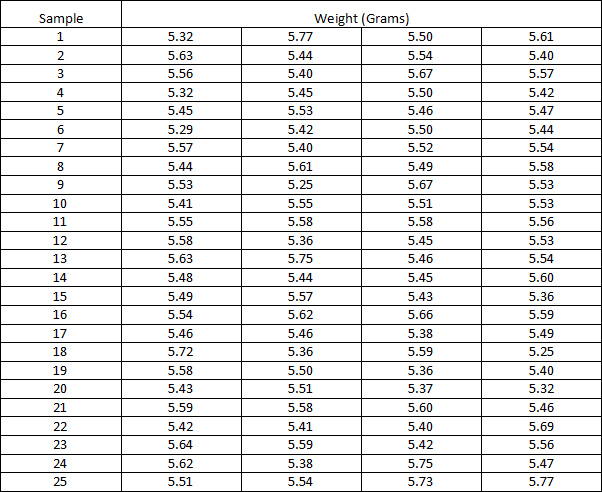
A filling machine for a tea bag manufacturer produces approximately 170 tea bags per minute. The process manager monitors the weight of the tea placed in individual bags. A subgroup of n=4 is taken every 15 minutes for 25 consecutive time periods. The results are recorded as follows:
a. What are some of the sources of common causes variation that might be present in this process?
b. What problems might occur that would result in special causes of variations?
c. Set up control charts for the range and the mean. (You must provide Minitab’s outputs)?
d. On the basis of the results in (c), indicate whether the process is in control.
e. On average, what is the % of tea bags will have weight fall within 5.2 grams and 5.8 grams. Can the process achieve 3-s control status?
Question 4
In a recent research article, researchers stated, “Some of the benefits of a capable process are increased customer satisfaction, increased operating efficiencies, and reduced costs.” To illustrate this point, the authors presented a capability analysis for a spring water bottling operation. One of the characteristics of interest is the amount of magnesium, measured in parts per million (ppm), in the water. The LSL and USL for the level of magnesium in a bottle are 18 ppm and 22 ppm, respectively. The data in the following table represent the magnesium levels (ppm) from 30 subgroups of size 4 collected over a 30-hour period:
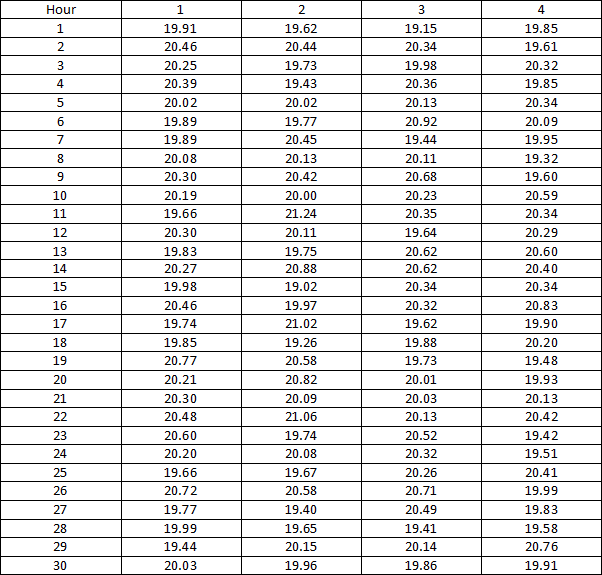
a. Set up a control chart for the range.
b. Set up a control chart for the average amount of magnesium.
c. Is the process in control?
d. If the process is in control, estimate the percentage of bottles within specifications.
e. If the process is in control, what are Cp, CPL, CPU and Cpk? (You need to hand-calculate the indices and check with the results of Minitab. You need to provide Minitab’s outputs as evidence as well).
Question 5
The manager of a branch of a local bank wants to study waiting times of customers for teller service during the peak time of 12 noon to 1p.m. a subgroup of four customers is selected (one at each 15-minute interval during the hour), and the time in minutes is measured form the point each customer enters the line to when he or she begins to be served. The results over a four-week period are as follows:
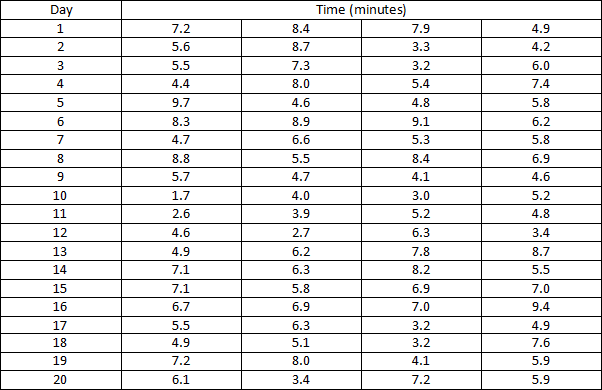
a. Set up control charts for the mean and the range.
b. On the basis of the results in (a), indicate whether the process is in control. (You must substantiate your arguments with evidence generated from Minitab)?
c. If the process is not in control, what would be the next action you propose to undertake and what is the result (You must substantiate your arguments with evidence generated from Minitab)?
d. Suppose management has set an upper specification limit of 9 minutes on waiting time. Assume that management has determined that at least 97% of the waiting times must be less than 9 minutes in order for the process to be considered capable.
1. Using Minitab, estimate the percentage of the waiting times that are inside the specification limits.
2. If management implemented a new policy stating that 97% of all waiting times were required to be within specifications, would this process be capable of reaching that goal? Explain.
2025-07-18