MINLP
Hello, dear friend, you can consult us at any time if you have any questions, add WeChat: daixieit
Problem 1
a) Use the starting point y1 = y2 = y3 = 1 to solve the following MINLP problem step-by-step with the outer-approximation algorithm (you may want to solve the MILP and NLP subproblems by GAMS/Pyomo). Integer cuts in each step should be explicitly formulated and presented.
b) Please also verify your solution with DICOPT or BONMIN solver in GAMS/Pyomo (please submit your source code file as well).
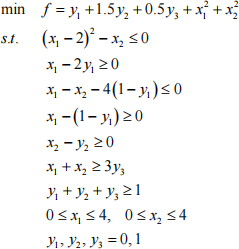
c) If we get the solution x1=2, x2=1, y1=1, y2=1, y3=0 in an iteration of outer-approximation algorithm, what is the corresponding integer cut to cut off this integer solution?
Problem 2
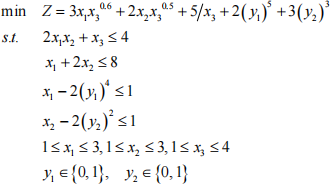
Reformulate the following nonconvex MINLP problem as a convex one
Problem 3
Given the bilinear NLP below, find the global optimal solution using the McCormick convex envelopes and a spatial branch and bound.
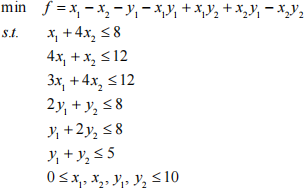
Verify your answer with DICOPT or COUENNE solver in GAMS/Pyomo (please submit your source code file).
[Hint: To obtain good initial lower and upper bounds solve LP’s for the bounds of the four continuous variables. For example, to get the best upper bound of x1, you can formulate an LP by maximizing x1 subject to all the constraints of the original problem. Similarly, minimizing x1 with the same constraints will give you the lower bound of x1.]
Problem 4
Reformulate the following inequalities as convex inequalities

Problem 5
It is proposed to manufacture a product C with a process I that uses raw material B. B can be purchased, manufactured with Process II, and/or manufactured with Process III. Both Processes II and III use chemical A as a raw material. In order to decide the optimal selection of processes and levels of production that maximize profit formulate the MINLP problem and solve it with DICOPT or BONMIN solver in GAMS/Pyomo (please also submit your source code file).
Data:
Conversion: Process I C = 0.9B
Process II B = ln(1 + A) Maximum capacity: 5 ton of B per hour
Process III B = 1.2 ln (1 + A)
(A, B, C, in ton/hr)
Prices: A $ 1,800/ton
B $ 7,000/ton
C $13,000/ton (maximum demand: 1 ton/hr)
Investment cost
|
|
|
Fixed (103$/hr) |
Variable (103$/ton product) |
|
Process |
I |
3.5 |
2 |
|
Process |
II |
1 |
1 |
|
Process |
III |
1.5 |
1.2 |
Problem 6
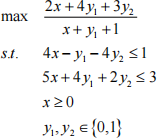
Solve the following mixed-integer linear fractional programming problem using (a) parametric algorithm and (b) reformulation-linearization algorithm by using an optimization solver for the MILP subproblems. Validate your solution using a deterministic global optimization solver (e.g. BARON, SCIP, Couenne, etc.) You might consider using the online platform (e.g. https://neos- server.org) if needed.
Problem 7
A nonlinear programming problem involves inequalities of the form  where x and y are bounded variables,
  and all the bounds are positive (i.e.
  and
and  ).
).
a) Can you show through step-by-step derivation that the following inequalities are over-estimators ofthe inequality z ≤ (x/y) . You may derive this over-estimators following the steps in the derivation of the McCormick convex envelopes, but please do not derive from McCormick convex envelopes directly.
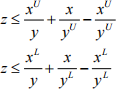
b) Is the above over-estimator convex or non-convex? Why? If it is non-convex, can you propose convex over- and under-estimators for the inequality z ≤ (x/y) ?
[Note: This is a bonus problem and not required – those students may work on it to earn an extra credit of at most 2 points that will be used to offset any possible loss of points from other problems, which are worth 10 points in total.]
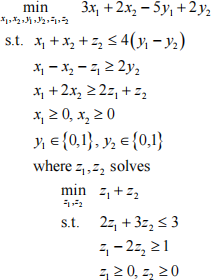
Please reformulate the following bilevel optimization problem into a single-level optimization problem that can be solved directly by GUROBI and CPLEX. You might use M to represent a sufficiently large number as the upper bound of any continuous variable.
2025-07-17
Mathematical Modeling