Lab #3 Redshift and the Expansion of the Universe – Unit G3
Hello, dear friend, you can consult us at any time if you have any questions, add WeChat: daixieit
Lab #3 Redshift and the Expansion of the Universe – Unit G3
OBJECTIVES:
a) Astronomers use numerous techniques to determine the distance to galaxies
b) Hubble’s law relates the redshift of galaxies to their distances from the Earth
c) Galaxies appear to be moving away from each other indicating the universe is expanding
d) Using data from a simulated telescope, students will determine the Hubble’s parameter and the age of the Universe in Part II.
INTRODUCTION
The Milky Way galaxy is an above average sized spiral galaxy belonging to a local group of about 54 other galaxies. Andromeda (aka M31) is similar to our galaxy in structure and size. It is our closest neighbor, a mere 2.5 million light-years away. John Burdon Sanderson Haldane, nicknamed "Jack" or "JBS", a British geneticist/biologist once wrote, “The Universe is not only queerer than we suppose, but queerer than we can suppose”. In 1608, the German-Dutch spectacle-maker, Hans Lippershey, invented a toy telescope that was turned into an astronomical instrument by Galileo Galilei one year later. This allowed astronomers to see far off objects in our universe with greater detail. Many hazy and diffuse patches were discovered amid the stars. Eventually, these patches were labeled “nebulae” and were thought to lie within the Milky Way. Our galaxy was once thought to be the entire universe. As individual stars were discovered within those nebulae, astronomers improved the telescopic power and optical quality only to realize that these objects were outside of the galaxy. Some of the stars seen in those “spiral nebulae” were identified as Cepheid Variables which meant that they exhibited a relationship between absolute brightness/luminosity and period variability from hours (RR Lyrae variables) to days, i.e. Polaris (north star).
In 1903 at the Lowell Observatory in Flagstaff, Arizona, Vesto Slipher was the first to measure the redshift of a spiral nebula (now known as a galaxy). Slipher realized that the redshift of the spectrum of the spiral nebula (galaxy) meant that it was moving away from us at a very high speed. In other words, the degree to which the lines in a spectrum are shifted indicates how fast the galaxy is moving. Figure 1 is an example of this concept. We know what hydrogen looks like in the lab on earth. Comparing Object 1 to the spectral line with wavelengths at rest, the right-hand side has shifted beyond the red end of the spectrum, redshifted, meaning it is moving away from us. Object 3 is example of blueshift, that means the object is coming towards us and the formula would yield a negative number. We can determine this by measuring the wavelength of the object and using this information to calculate its speed.
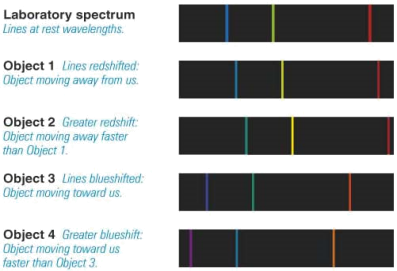
Figure 1. Spectral Lines for Hydrogen
In 1923 the American Astronomer, Edwin Hubble discovered that all galaxies have redshifts by using these Cepheid variable stars in “spiral nebulae”. He was able to prove that these objects lie outside of the Milky Way galaxy. At first, astronomers labeled them “Island Universes” but we now know that they were galaxies. Several years later in 1929, Edwin Hubble and Milton Humason put their observations together in a way that led to the first realization that the universe changes – in fact, the universe is expanding! Hubble was able to show that the speed of a galaxy was directly proportional to its distance from our own galaxy. In other words, the further an object is away, the faster it was moving. This became known as Hubble’s law and is represented mathematically as:
v = H0 x d Equation 1
where v = velocity in km/s, d = distance in Mpc, and H0 is known as Hubble's constant with an accepted value of approximately 73km/s/Mpc.
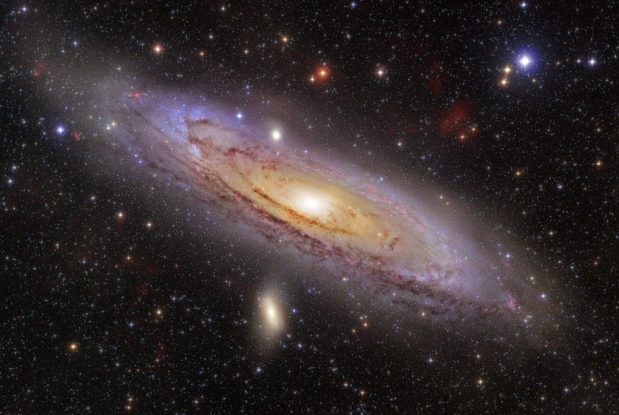
Figure 2. The Andromeda Galaxy
Part I (5 points each)
G3-1 The Spiral Nebulae
The Andromeda Galaxy (M31) was one of the first to be recognized as an "Island Universe" outside of the Milky Way. The Andromeda Galaxy is, in fact, the nearest spiral galaxy to our own Milky Way Galaxy. It is very similar to the Milky Way in size, mass and structure.
Question 1: The Andromeda Galaxy is the most distant celestial object that can be seen with the unaided eye. How far away from the Milky Way is the Andromeda Galaxy located? Hint: Press the Info button in the selection label.
a. 9.2 million light years
b. 2.5 million light years
c. 9.2 billion light years
d. 2.5 billion light years
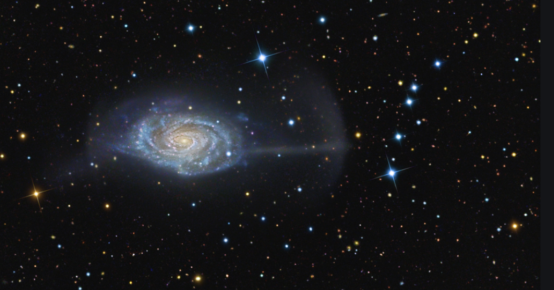
Figure 3. The Virgo Cluster
G3-2 Distant Galaxies
Hubble measured the displacement of known absorption lines in the spectra of stars from distant galaxies; these lines were shifted towards the red end of the spectrum. The greater the displacement, the faster the galaxy was receding as seen in Figure 1 above. The greatest recessional velocities belonged to the most distant galaxies. This relationship between recessional velocity and distance is known as Hubble's Law. In this exercise, the Main Window shows the location of the Virgo cluster of galaxies. Select a few of the numbered galaxies in turn and bring up the Info panel. Note: write down the listed distance for each galaxy in Mly. You will see that these galaxies are between 50 and 60 million light years away. The relationship 1Mpc = 3.26 ly shows that these distances correspond to an approximate overall distance of 17 megaparsecs (Mpc)
Question 2: Use Hubble's Law to calculate the recessional velocity of the Virgo cluster of galaxies. How fast are these galaxies receding away from us?
a. 1240 km/sec
b. 2480 km/sec
c. 124 km/sec
d. 1.24 km/sec
Using Hubble's Law, the observed redshift of an object can be used to determine a galaxy's distance. The red shift Z is the ratio of the shift in wavelength to the unshifted wavelength (reference wavelength) of a measured spectral line (this shift is assumed to be caused by the Doppler Effect):
Z = v/c Equation 2
where Z = redshift, v = observed recessional velocity in km/sec, and
c = 300,000 km/sec, the speed of light in space. The redshift, Z can also be represented mathematically as:
 Equation 3
Question 3: Using the formula z=v/c, what is the redshift of the galaxies in the Virgo cluster?
a. 0.04
b. 0.004
c. 0.0004
d. 0.4
G3-3 Deep into the Universe
The current view in Main Window shows part of the Abell cluster of galaxies (See Figure 4 below). The Abell cluster is located 600 Mpc away.
Question 4: What is the calculated recessional velocity of the Abell cluster of galaxies?
a. 24,000 km/sec
b. 2,400 km/sec
c. 4,200 km/sec
d. 42,000 km/sec
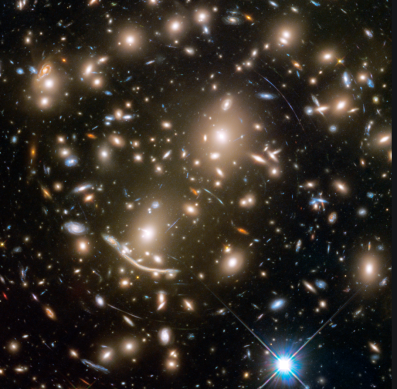
Figure 4. Abell Cluster
Question 5: For the Abell cluster of galaxies z = 0.14, and for the Virgo cluster z = 0.004. What can be said about the relationship between distance and redshift from this small sample of redshifts?
a. Smaller redshift values correspond to greater distance.
b. Larger redshift values correspond to less distance.
c. Larger redshift values correspond to greater distance.
d. There is no relationship between redshift and distance.
2025-06-30