Laboratory work №5
Hello, dear friend, you can consult us at any time if you have any questions, add WeChat: daixieit
Decision Making Lab5
Laboratory work №5
Topic: Study of decision-making criteria under conditions of statistical uncertainty
Goal of the work:
- to study the conditions of application of decision-making criteria under risk conditions;
- to study the algorithms for using decision-making criteria under risk conditions;
- implement the use of criteria in the MS Excel environment.
The order of work
1. Study theoretical information about the essence of the problem of decision-making in conditions of risk.
2. Study the peculiarities of decision-making criteria in conditions of risk.
3. Choose the subject area of decision-making.
4. Perform verbal formulation of decision-making tasks in the chosen subject area, define target functions.
5. In the MS Excel environment, create a revenue matrix and a cost matrix with 5 alternatives, 5 states of the decision-making environment and the probabilities of these states.
6. Search for solutions using each criterion (from those proposed in the theoretical part of the instructions) to find solutions.
7. Compare the obtained solutions. Explain the results. Demonstrate the process of finding solutions to the teacher.
8. Make a report on laboratory work.
9. Defend laboratory work.
Content of the report
1. Topic of the work.
2. Goal of the work.
3. Individual task.
4. Description of the work execution.
5. Interpretation of the obtained results.
6. Conclusions.
Individual tasks
Research the use of all proposed criteria for solving problems in the selected subject, performing the necessary calculations in MS Excel.
BRIEF THEORETICAL INFORMATION
1 Decision-making under conditions of statistical uncertainty
When making decisions under conditions of statistical uncertainty (risk), it is assumed that each alternative corresponds to its own distribution of probabilities for a set of outcomes. If the set of alternatives and outcomes is finite, then the probabilities of all outcomes when choosing a given alternative are considered known.
The connection between alternatives and results is probabilistic in nature, when the choice of alternative x determines the probabilities of the results on the set Y. In this case, the choice of x does not guarantee the occurrence of a certain result y, and the decision-making task is called the decision-making task under risk conditions (Fig. 1) .
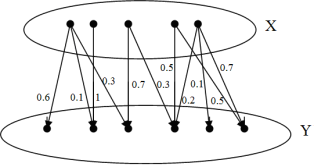
Figure 1 – A probabilistic relationship between alternatives and outcomes
The graph of probabilistic relationships in fig. 1 is weighted – each arrow has a weight, that is, the probability Рi of obtaining the result уj when choosing the alternative х. For any i probabilities of pairs (хi , уj) are incompatible:

Consider the decision-making problem in the general case when there are n alternatives х1, … , хn and l results у1, … , у l.
The states of the environment are possible combinations of alternatives and results of mappings zj: X → Y, j=1, … , S. In the case of finite sets X and Y, we have

where Sj – the number of combinations of alternative xj and possible outcomes;
S – the maximum possible number of such combinations.
Selecting the state of the environment zj and alternative хi completely determines the result уj(хi).
Each state of the environment zj corresponds to the probability of its occurrence

where pi(yj(xi)) – given probability of the result yj when choosing an alternative xi.
To calculate р(z), one should multiply the probabilities of events causing the state zj. After that, you can build a table of the implementation function.
The possibility of presenting the problem of decision-making under conditions of risk in the form of a realization function means that the statistical uncertainty, which is manifested in the ambiguous (probabilistic) relationship between the alternative and the result, can be interpreted as the influence of the environment on the result. An example of such a task can be the adoption of optimal design decisions in the conditions of technological spread of product parameters.
When making a decision under conditions of uncertainty, it is important to distinguish between two main situations:
1) the result of у є Y, which corresponds to the solution of x, is realized multiple times (for example, the choice of design parameters of a mass-produced product);
2) the result у is implemented once (for example, choosing the optimal parameters of a unique product).
In situation (1), it is advisable to replace the decision-making problem with a probabilistic problem and choose such an alternative x that maximizes the mathematical expectation of the criterion, i.e., is a solution to the problem

where  – is the mathematical expectation of a random variable J(x, z).
In the case when the sets of alternatives X and results Y are finite, the situation of choosing an alternative under conditions of uncertainty can be presented in the form of a decision matrix (Table 1).
Table 1 – A decision matrix
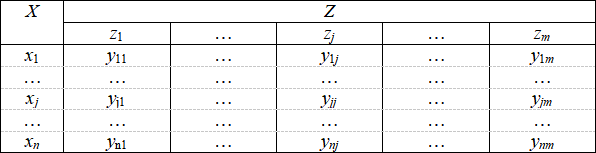
Vector Z={ z1, … , zm} describes the uncertainty of the situation and is assumed to be finite, as are the vectors of alternatives Х={x1, … , xn} and Y={y11, … , ynm}. That is, we have a function of two arguments у=F(x, z): X x Z → Y.
The decision matrix should be understood as follows. If the solution xj is selected, different results can be realized from the corresponding row of the matrix: yj1, … , ynm. Exactly what result is realized depends on the value of the uncertainty parameter z, which can have different meanings.
2 Methods of finding solutions under risk conditions
The most common methods of finding solutions under risk conditions are the following methods (criteria): Bayes-Laplace, Bernoulli, Khoja-Lehmann, minimum variance of the estimated functional, Hermeyer, subjective-average regret, Khomenyuk.
Let's consider the features of the methods and examples of their application.
1. Bayes-Laplace criterion – hope for an average result:
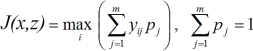 (for the revenue matrix);
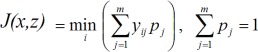 (for the cost matrix)
where aij – evaluation of the result, pj – state probability zj.
The rule for choosing the optimal alternative based on the solution of the optimization problem is called the mathematical expectation criterion (Bayes-Laplace criterion). If we assume that the functional J characterizes the "utility" or "revenue" obtained from the decision x and the realized revenue, then the mathematical expectation can be considered as "average revenue" and, solving the problem, we actually maximize the "average revenue".
2. Bernoulli's criterion – hoping for an average result with insufficient information about the environment:
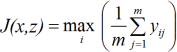 (for the revenue matrix),
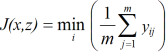 (for the cost matrix).
This criterion is applied in conditions of complete uncertainty, when there is no information about the possible states of the environment z.
The criterion of insufficient basis is as follows. If there is no evidence to consider one event from a complete system of incompatible events more likely than the others, then all events should be considered with equal probabilities. With a finite number of considered sets, this principle leads to an evaluative function
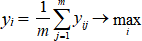
Multiplier 1/m can be omitted without changing the ordering of the alternatives, and after that proceed to the summation operation of "revenues" along the rows of the decision matrix.
3. Khoja-Lehman criterion - guarantees a certain minimum:

where parameter с (0≤c≤1), on the one hand, sets the degree of confidence in the probability distribution, and on the other hand, the degree of undesirability of the appearance of very small values.
2025-06-21
Study of decision-making criteria under conditions of statistical uncertainty