Laboratory work №4
Hello, dear friend, you can consult us at any time if you have any questions, add WeChat: daixieit
Decision Making Lab4
Laboratory work №4
Topic: Search for Pareto-optimal solutions
Goal of the work:
- to study the definition and properties of a set of Pareto-optimal solutions;
- to study the algorithm for constructing Pareto-optimal solutions;
- implement the algorithm in the MS Excel environment.
The order of work
1. Study the idea of the concept of Pareto-efficient, weakly efficient solution and the algorithm for forming the Pareto set.
2. Choose a subject area for decision-making according to an individual task (the same as laboratory work #1).
3. Perform a verbal formulation of the decision-making problem in the selected subject area and determine 6 alternatives, evaluating them according to 5 criteria.
4. In the MS Excel environment, create the tables necessary for solving the problem.
5. Search for Pareto-optimal solutions.
6. Explain the results. Demonstrate the process of finding solutions to the teacher.
7. Make a report on laboratory work.
8. Defend laboratory work.
Content of the report
1. Topic of the work.
2. Goal of the work.
3. Individual task.
4. Description of the work execution.
5. Interpretation of the obtained results.
6. Conclusions.
Select the problem area according to the ID in the group list. Search for solutions for the given problem area (Table 1).
Table 1
|
ID |
Problem area |
|
1 |
Personnel of the enterprise |
|
2 |
Enterprise equipment |
|
3 |
Service provider |
|
4 |
Job |
|
5 |
Home appliances |
|
6 |
Housing rent |
|
7 |
Banking sphere |
|
8 |
Computers |
|
9 |
Buying food |
|
10 |
Public transport |
|
11 |
A place for relax |
|
12 |
Vehicles |
|
13 |
Clothing |
|
14 |
Furniture |
Theoretical material
The Pareto principle and the concept of a Pareto-efficient and a weakly efficient solution are important for multi-criteria decision-making problems.
If the quality or usefulness of the result is determined not by one number, but by several, then it means that there are several indicators of the quality of the solution, described by private objective functions
fk: Y à R, r=1, 2, … ,m,
which need to be maximized.
The following dominance relations are usually used in the theory of multi-criteria problems:
(yi,yj) є Rp ↔  k: [fk(yi) ≥ fk(yj)] /\ [f(yi) ≠ f(yj)];
(yi,yj) є Rs ↔  k: [fk(yi) ≥ fk(yj)],
here f=(f1, f2,… , fm).
Dominance relationship Rp is called the Pareto ratio, and the ratio Rs is Slater's ratio.
If for some point yо ∈ Y there is no point more dominant by Pareto, i.e., such a point y that (у,уо) ∈ Rр, that's the point уо is called an efficient or Pareto-optimal solution to a multi-criteria problem
fk(y) à max, k=1,2, … ,m; y ∈Y.
The set that includes all effective elements of the set Y is denoted by Pj(Y) or P(Y), and is called the Pareto set for a vector relation
f: Y à Rm, f=(f1, f2,… , fm).
The set P(f) = f(P(Y)) is called the set of effective estimates. The meaning of the set of efficient estimates is that the optimal result should be sought only among the elements of the set of non-dominated elements P(Y) (the Pareto principle). Otherwise, there will always be a point у ∈ Y, which is more dominant considering all private objective functions.
The effectiveness of the solution cannot be improved on any indicator without worsening the situation on the remaining indicators.
Pareto optimality is a state of the system in which the value of each individual criterion that describes the state of the system cannot be improved without worsening the situation of other elements.
Thus, in Pareto's own words: "Any change that does no harm to anyone and benefits some people (in their own estimation) is an improvement." Therefore, the right to all changes that do not cause additional harm to anyone is recognized.
A set of Pareto-optimal system states is called a "Pareto set", "a set of Pareto-optimal alternatives".
A situation where Pareto efficiency is achieved is a situation where all benefits from exchange have been exhausted.
A point у′ ∈ Y is called a weakly efficient solution of a multicriteria problem, or a Slater-optimal solution, if there is no Slater-optimal point, i.e., a point y such that (у,у') ∈ Rs.
The result y is called weakly efficient if it cannot be improved at once according to all m criteria specified by means of private objective functions fi(y), I=1,2, … ,m.
The set of weakly effective elements is denoted by Sf(Y) or S(Y). As a result of multicriteria optimization, these solutions are often obtained, although they are of less interest than efficient solutions.
It should be noted that the construction of the Pareto set arises in the process of solving a complex multi-criteria decision-making problem and is determined by its features, the specifics of LPR advantages, and the availability of an instrumental tool for visualization and analysis.
Example
We have 7 alternatives, evaluated by experts in points according to the criteria Reliability, Productivity, Ease of use, Ease of manufacture, Design:
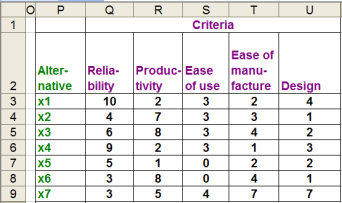
It is necessary to solve the problem of choosing equipment.
2025-06-21
Search for Pareto-optimal solutions