EECS 551 Midterm 1
Hello, dear friend, you can consult us at any time if you have any questions, add WeChat: daixieit
EECS 551 Midterm 1
1. Let x ∈ F N and y ∈ FM and U ∈ FM×N . Select the true statements.
a: If M = N and U is unitary then ∥Ux∥2 = ∥x∥2
b: If U is semi-unitary then ∥Ux∥2 = ∥x∥2
c: If M = N and U is unitary then ∥Ux − y∥2 = ∥x − U′y∥2
d: If U is semi-unitary then ∥Ux − y∥2 = ∥x − U′y∥2
e: None of these
2. If A and B are Hermitian symmetric matrices of the same size, then which of the following must be Hermitian matrices?
a: A + B
b: AB
c: AB′
d: αA for α ∈ F
e: 
f: A+
g: None of these
3. Let B denote a Hermitian symmetric matrix. Which statements are true?
a: The eigenvalues of B are real.
b: The eigenvalues of B are non-zero.
c: Any singular value of B is also an eigenvalue of B.
d: Any right singular vector of B is also an eigenvector of B.
e: None of these
4. If B ∈ F N×N then which of the following statements are correct?
a: R(B) = F N
b: R(B) ⊆ F N
c: rank(B) = N
d: dim(R(B)) ≤ N
e: dim(R(B)) + dim(N (B)) ≤ N
f: dim(R(B)) > 0
g: dim(N (B)) > 0
h: None of these
5. Suppose matrix A has an SVD  and y ∈ R(U2). If xˆ denotes the minimum-norm least-squares solution to Ax ≈ y, then which statements are true?
a: ∥xˆ∥ = 0
b: y ∈ R(A)
c: xˆ ∈ N (A)
d: None of these
6. Let X ∈ FM×N have rank 1 ≤ r ≤ min(M, N), and define Y = XX+XX′X. Let A denote the set of right singular vectors of X and let B denote the set of right singular vectors of Y . Which of these statements are true?
a: A = B
b: A is a strict subset of B
c: B is a strict subset of A
d: A has cardinality one
e: A is a subspace of dimension one
f: A is an empty set
g: B is an empty set
h: None of these
7. The projection of the vector  onto the subspace span
 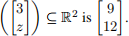 Determine z.
a: -1
b: 0
c: 1
d: 2
e: 3
f: 4
8. Matrix C ∈ F N×N has rank 0 < r < N and an SVD of C is C = [U1 U2] Σ [V1 V2] ′ , where U1 = [u1, . . . ,ur], V1 = [v1, . . . , vr] and Σ is diagonal.
Which of these is/are a projection matrix onto the null space of the Hermitian transpose of C:
a: I − U1U1 ′
b: I − V1V1 ′
c: U1U1 ′
d: V1V1 ′
e: V2U2 ′
f: V1U1 ′
g: U1V2 ′
h: U2V1 ′
9. Matrix A is N ×3 and matrix B is M ×3 and they each have an SVD that uses the same 3×3 right singular vector matrix V . A has singular values {1, 1, 2} and B has singular values {1, 2, 3}. Determine det{A′A + B′B} .
10. Hermitian matrix B has unitary eigendecomposition  where V1, V2, and V3 have 4, 5 and 6 columns, respectively. Find the simplest expression for the projection matrix for N (B).
11. Hermitian matrix A has eigenvalues {−4, −1, 6}. Define B ≜ −5I + 3A. Determine the spectral norm of B.
12. Let A ∈ FM×N have rank r > 0 and have SVD A = UΣV ′ . Let Q denote a M ×M unitary matrix and define B ≜ QA. Specify an orthonormal basis for R⊥(B) in terms of (parts of) Q, U, Σ and/or V .
13. Matrix A has singular values 2/k for k = 1, . . . , 8 and 0 for k = 9, . . . , 20, with corresponding left singular vectors u1, . . . , u20. Determine ∥A+u6∥2 .
14. Let V = R 2×2 over the field R, the vector space of real 2×2 matrices. Let S denote the subspace of V consisting of Hermitian matrices. Specify the dimension of S and give a basis for S.
15. Given a matrix B ∈ CM×N and a vector y ∈ CM, respectively, complete the following JULIA function so that it efficiently computes the Euclidean distance between y and the point closest to y in R(B). For full credit, do not use any SVD operations.
function dis_range(B, y) 
16. Let x, y and z denote three nonzero orthogonal vectors of the same dimension. Complete the following JULIA function so that it returns the Moore-Penrose pseudoinverse of the matrix A = xx′ + yy′ + zz′ , computed as efficiently as possible.
(Do not call svd or pinv .)
function pinvorth(x, y, z) 
2025-05-30