ELEC4310: Power System Analysis Assignment 4
Hello, dear friend, you can consult us at any time if you have any questions, add WeChat: daixieit
ELEC4310: Power System Analysis Assignment 4
Transient Stability
Submission due date: 4 pm Friday, 30th May 2025
Use the provided base case 13-bus power system (System Base: 100 MVA.) and perform the dynamic simulations listed under “Dynamic Study” using PSS/E and Python Interface.
Note:
 Studies conducted using the PSS/E GUI are not accepted.
 You can use the PSS/E GUI to visualise the results using “.out” files generated during Dynamic Studies simulated using Python.
 Use a simulation time of 30s,
 All events occur at 10s and are cleared after 0.15s
 X is the last digit of student numbers (e.g. 4631851, X=1)
o If X=0, then change into 10 (e.g. if X=0 , then use X = 10)
The report should include a concise summary of results:
 Screenshot of PSSE Solution, Python Scripts and graphs for comparisons.
 Comments and discussions must accompany each section. It may be a short paragraph.
 Each section must have its corresponding saved .py and .out files attached to the submission .zip file.
Dynamic study
1) Perform bolted three-phase balanced fault analysis for the Slack Bus. Plot the frequency and
voltage response of the slack bus. Please comment on the results.
Hint: You may use the function DIST_BUS_FAULT/ DIST_BUS_FAULT_2.
(Results: 5 Marks + Script: 5 Marks = 10 Marks)
2) Perform line-to-ground fault and line-to-line-to-ground fault at Bus X+1 with a fault
impedance of 0.05+j0.1 pu. Plot the voltage and frequency response of the slack bus and fault bus. Compare the plots with the previous question. Please comment on their similarities and differences.
Hint: You may use the function DIST_SCMU_FAULT/ DIST_SCMU_FAULT_2.
(Results 10 Marks + Script 15 Marks = 25 Marks)
3) Perform a bolted line-to-line-to-ground fault at the location shown in Figure 1, where x is
45% of the length of the transmission line between Bus 8 and Bus 9. The transmission line is tripped after the fault is cleared. Plot the voltage of Bus 8, Bus 9 and the slack bus and the frequency response of the slack bus. Please comment on the results.
Hint: You may use the functions LTAP, DIST_BUS_FAULT_2, DIST_SCMU_FAULT_2 and DSCN.
(Results 10 Marks + Script 15 Marks = 25 Marks)
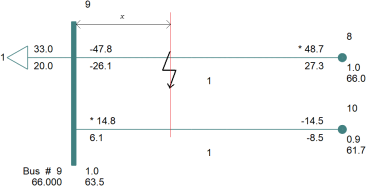
Figure 1 Fault configuration
4) Trip the generator in Bus 8 at 10s. Plot the frequency response of the slack bus, voltage
response of the Slack bus and Bus 8 and the power output of the Slack Bus generator and the generator that tripped. Please comment on the results.
Hint: You may use the function MACHINE_CHNG_2.
(Results 10 Marks + Script 10 Marks = 20 Marks)
5) Disconnect the load at Bus X+3 at 10s. Plot the voltage of the Slack bus and the chosen bus (i.e. bus X+3), the frequency response of the Slack bus, the active power of the Slack bus generator and the chosen load. Please comment on the results.
Hint: You may use the function LOAD_CHNG_5, LOAD_ARRAY_CHANNEL.
(Results 10 Marks + Script 10 Marks = 20 Marks)
IMPORTANT SUBMISSION INFORMATION
(a) All case (.sav) files, diagram (.sld) files, and Python (.py) scripts must be named appropriately. There should be one folder for each task. Compress all five folders in a single zip file, called ‘########_Psse_files’, where ######## is your 8-digit student number.
(b) Your report must be submitted as a PDF file to Blackboard. The report itself should not be included in the zip file.
(c) Make sure you have answered all the questions.
(d) This report should be no more than 15 – 20 pages (one-sided only, Times New Roman font size
12, single line spacing with 2 cm margin on all sides). Appendix does not count. You should place tables and graphs into the body of the report. The report's figures, tables and codes are counted in the page limit.
(e) The report must include a concise summary of each section's results, along with comments and discussions. It could be as short as one sentence or as long as a paragraph.
(f) Place figures as close as possible to where you refer them in the context.
2025-05-22