110.304 Data Analytics for Accounting and Business Assessment 2
Hello, dear friend, you can consult us at any time if you have any questions, add WeChat: daixieit
110.304 Data Analytics for Accounting and Business
Assessment 2: Individual Report Using Data Analytics Tools
2025 Semester 1, Distance
1 The purpose of this assessment
This Assessment 2 aims to assess your ability to apply statistical techniques used in data analytics to “real-life” financial data. You are expected to utilise the knowledge gained through your study material (week 6 to week 9 in 110.304). You are also encouraged to draw on your knowledge gained from other courses and any other information you have acquired from your own research and/or work experience to prepare an analysis and communicate it to various stakeholders.
Objectives: LO-1 to 4
The assignment will also cover the course’s key generic competencies:
• Develop a data analytics mindset.
• Experience sourcing real raw data and applying extraction, transformation, and loading (ETL)
techniques to prepare the data for analysis.
• Improve your database problem-solving skills.
• Encounter real data problems and employ statistical tools and techniques learned in this class (and beyond) to solve them:
— Descriptive analytics approach, distributions, sampling approach and diagnostic approach for initial analysis;
— Hypothesis testing for differences in groups, confidence interval estimations, analysis of variance and tests of statistical significance;
— Regression analysis for hypothesis testing, including testing model fitness.
• Interpret the results and communicate to users.
Assessment 2 consists of a 1000-word report (excluding the reference list and appendices) and workings on an Excel worksheet.
Further details on presentation and marking guidelines are included in the Assessment 2 details below.
“Employee Review and Earnings Management: Evidence from Australia”
Emerging evidence suggests that employees actively use public earnings information to assess the relative value of their current employment against external job opportunities. Dehaan et al. (2022), using Glassdoor review activity as a proxy for employee job search, find that such activity intensifies around earnings announcement (EA) weeks—particularly when internal information is scarce or external labour market conditions are favourable. This underscores that earnings reports serve not only as signals for investors but also as important cues for employees assessing firm performance, job security, and career progression. While traditional accounting literature has largely focused on how earnings management might be affected by investors’ and capital providers’ sentiment, this case study shifts the focus to employees as key internal stakeholders. This individual report requires you to explore how employee review activity may influence firms’ earnings management activities. Managers can manage earnings in two ways- (1) Discretionary accruals (DACC) and (2) Real earnings management (REM1 & REM2).
1. Discretionary accruals (DACC) are accounting adjustments made by management to manipulate/manage financial results. They are considered discretionary because they are not necessary for the company’s
day-to-day operations but are used to meet certain financial objectives or manage the appearance of the company’s financial performance. Discretionary accruals can include adjustments to estimated expenses, such as allowances for bad debts or inventory write-downs, as well as adjustments to revenue recognition practices. These adjustments can be made to either inflate or deflate reported earnings, depending on the reporting entity’s goals.
While discretionary accruals can be legal, they can also be used to engage in financial fraud or to mislead investors. As a result, regulatory agencies such as the Australian Securities & Investments Commission (ASIC) closely monitor the use of discretionary accruals and require companies to disclose the extent to which they have been used in financial reporting.
2. Real earnings management (REM) uses operational or business activities to manipulate a company’s
financial results. This differs from accrual-based earnings management, which involves manipulating
accounting entries to manipulate financial results. Real earnings management typically involves
actions taken by management to either increase or decrease reported earnings through operational
decisions. For example, a company may defer maintenance on equipment to reduce expenses in the
current period or accelerate sales to increase revenue in the current period. These actions are often
taken in response to financial pressures, such as meeting earnings targets or increasing share prices.
While real earnings management is not necessarily illegal, such distortions can signal uncertainty about a firm’s true financial health, long-term viability, or strategic direction. Cost-cutting or re- duced investment in growth initiatives may imply constrained career development opportunities, lower future wages, or increased risk of layoffs. Employees—especially those without access to in- ternal financial data—may interpret these signals as red flags, prompting them to reevaluate their current roles and explore alternative job prospects.
In Australia, financial reporting plays a vital role not only in capital allocation but also in shaping labour market behaviour. While many large ASX-listed companies today are less dependent on external financing due to strong cash reserves, their most critical resource is human capital. As shown in economics and man- agement literature, voluntary employee turnover imposes significant costs—from recruitment and onboard- ing to the loss of institutional knowledge and productivity. In this context, earnings announcements have become an increasingly influential tool for employees to assess job-related risks and opportunities. These dynamics have attracted the attention of regulators. The Australian Securities and Investments Com- mission (ASIC), particularly during periods of economic uncertainty such as the COVID-19 pandemic, has expressed concern over the potential for earnings manipulation. ASIC noted that some firms may have employed aggressive accounting or operational tactics in 2020 and 2021 to present a more favourable financial position. In response, it required firms to justify any significant deviations from prior perfor- mance—highlighting the regulator’s broader commitment to financial transparency.
Yet the consequences of earnings management extend beyond investor deception. When employees rely on earnings reports as one of their few transparent signals of firm health, any distortion may lead to mistrust, misinformed career decisions, and higher turnover. This is especially relevant when manipulated reports conceal declining investment in staff, suppression of labour costs, or signs of organisational instability, thus may serve as a key trigger for job search activity. Even if a company appears financially sound on paper, employees may still respond to subtle cues in earnings reports—particularly if they sense inconsistencies or signs of short-termism.
To examine these dynamics in greater depth, ASIC has initiated an investigation into potential earnings management practices among SP/ASX200 firms during the period spanning 2014 to 2023—capturing both pre- and post-pandemic conditions. The project employs a two-stage data analytics approach: beginning with data preparation and exploratory analysis in Excel, and progressing to advanced statistical modelling in RStudio. The goal is to identify firms that may have engaged in earnings management and to evaluate the potential impact of these practices on internal stakeholders, particularly employees. By exploring the intersection of financial reporting quality and employee decision-making, this case provides new insights into how employee sentiment could be a potential factor for earnings management, particularly to capture the significance of workforce behaviour. The findings aim to inform regulatory oversight and support the development of more transparent, employee-conscious reporting practices within Australia’s corporate environment.
Wilson, M. (2011). Earnings management in Australian corporations. Australian Accounting Review, 21(3), 205-221. (Must read!!)
Enomoto, M., Kimura, F., & Yamaguchi, T. (2015). Accrual-based and real earnings management: An in- ternational comparison for investor protection. Journal of Contemporary Accounting & Economics, 11(3), 183-198. (Must read!!)
Dehaan, E., Li, N., & Zhou, F. S. (2023). Financial reporting and employee job search. Journal of Accounting Research, 61(2), 571-617.
1.3 Task 1: Perform ETL and initial analysis
1. Download two files containing 200 companies’ data in XLSX format and an Excel work file labelled ‘2025 Working Excel File Assessment 2’ from the Stream site. You are required to complete all the steps for task 1 in the Working Excel File.
2. First, open the ‘2025 Working Excel File Assessment 2’ to combine the two Excel files into a single dataset using Power Query. While combining data in Power Query, you must also carry out the data transformation process using Power Query. Follow the week 6 materials to complete this task. The steps in Power Query that involve cleaning and transforming the data are as follows:
• Combining/merging files for transformation.
• Checking datasets to be “sufficiently different” in format/structure from one another.
• Paying close attention to the state of the data and cleaning as necessary to improve the data quality and subsequent analysis. Common data cleaning procedures may involve:
(a) Formatting the date to match the acceptable format for your tool. Also, correct/exclude when encountering special characters (*, #, “, ’) or missing data. (e.g., apply the filter in Power Query)
(b) Watching for invalid number formats when starting sorting. For example, accounting symbols such as dollar signs, commas, and parentheses are pervasive in spreadsheet data (e.g., $12,345.22 or (1,422.53)).
(c) Splitting column if it contains two different pieces of information in one. (e.g., Split column - By Delimiter)
(d) Generating, excluding, renaming and labelling variables to prepare the data for anal- ysis.
(e) Remove duplicate items based on suitable criteria (e.g., Company ID, year).
(f) The last observation should be 2,154.
3. Once you are happy with the transformation process, save and load the data into the ‘2025 Working Excel File Assessment 2’ and copy the data to the worksheet named 1. Final Data (and delete the old one!). Now, you will conduct some basic analysis using the final data as per the following instructions.
• Using a pivot table, calculate the DACC, REM1 and REM2 by industry, year and company.
(make sure you take the average value rather than the total)
• Create a bar chart by industry and a scatter plot by the company for DACC, REM1 and REM2.
4. Once you have finished with the initial analysis in Excel, then save the file and transfer graphs and initial results to the individual report’s first part as per the template and explain the following aspects of the initial findings:
• Do the Bar chart (Graph 1.1 & 1.3) plots initially reveal any potential earnings man-
agement? By comparing the bar chart (Graph 1.1) between DACC, REM1 and REM2, can you identify which industries are more significantly involved with downward earnings management?
• Describe how the earnings management has varied over time in relation to employee reviews in Graph 1.2. Identify the key changes in the relationship between EM and employees’ reviews pre and post-COVID-19 pandemic. (take 2019 as the cutoff point to compare the pre and post-changes)
• Identify skewness of DACC, REM1, REM2 and ENR.
• Once Task 1 is complete, create a separate Excel file based on the “Final Data” work- sheet from the “2025 Working Excel File Assessment 2.” Save this new file with an appropriate name, such as R File (.xlsx).
*Earnings management could be managed both upward and downward. Therefore, industries/firms with too much upward and downward value earnings represent a higher risk of earnings management.
1.4 Task 2: Performing the test using statistical tools and analysing the results
Data Analytics approaches rely on a series of statistical techniques that are used to understand data and gain insights into the underlying causes and effects of business decisions. You will use Rstudio to perform the following statistical tests to generate results that you will use later for recommendations. The definitions of variables are provided below:
Table 1: Variable descriptions
|
Definitions |
DACC Represent accrual-based earnings management that is estimated using a mod-
ified Jones (1991) model.
ENR Employee negative reviews (ENR) measured as the natural logarithm of a
firms’ Glassdoor review on a fiscal year plus one, otherwise 0. (Use Employee negative review column to generate the variable)
VISIBLE Dummy variable equals 1 if the firm’s yearly news coverage falls above the
sample period’s median news coverage and zero otherwise. (Use News column to generate the variable)
SIZE Represent firms’ size measured as the natural logarithm of a firm’s total assets.
(Use TotalAssets column to generate the variable)
LEVERAGE Represent firm debt position measured as long term debt scaled by total assets.
(Use LongtermDebt column to generate the variable)
MTB Represent market to book ratio measured as the market value of equity (Use
MarketCapitalisation) divided by the book value of equity (Use TotalShare- holdersEquity).
LOSS Represent loss firms measured as an indicator variable that takes the value of
1 of firms’ net income is below 0 otherwise, 0 (Use NetIncomeAfterTaxes).
FCF Represent cash flow measured as free cash flow scaled by total assets. (Use
Freecashflow column to generate the variable)
ANALYSTS Represent number of analysts’ following measured as the natural logarithm
of a firms’ number of analyst following on a fiscal year plus one, otherwise 0.
(Use AnalystCoverage column to generate the variable)
ZScore Altman’s Z-score, defined as (3.3 * Operating income (IOADP) +
Sales(SALE) + 1.4 * Retained earnings (RE) + 1.2 * (Current assets (ACT)
– Current Liability (LCT))) / Total Assets (AT)
BIG4 Dummy variable equals 1 if firms belong to the big four firms and 0 otherwise.
A. Descriptive analysis
A1. Load R File (.xlsx) in RStudio and estimate ENR, VISIBLE, SIZE, LEVERAGE, MTB, LOSS, FCF, ANALYSTS variables based on the definition in Table 1. Create Table 2.1 and generate summary descriptive statistics for DACC, REM1, REM2, ENR, VISIBLE, SIZE, LEVERAGE, MTB, LOSS, FCF, ANALYSTS, ZScore and BIG4 . Also, generate Table 2.2 and present summary statistics of mean value for all variables by industry (Use GICSSectorName to categorise it).
A2. Create Table 2.3, present the estimated Pearson correlation matrix for all variables, and identify any possible multicollinearity.
A3. Use VISIBLE as a dummy variable to represent high VISIBLE = 1 or less VISIBLE = 0 visible
companies based on the level of news coverage (Use News column to generate the variable) .
• Create Table 2.4 and present a subsample based on high visible and less visible firms and perform summary statistics of all the variables in Table 1 for both subsamples.
A4. Estimate the simple regression model and present it in Table 2.5
EM = β0 + β1ENR + ϵ (1)
Where EM is either DACC, REM1 or REM2. ENR is employee negative reviews measured as the natural logarithm of a firms’ Glassdoor review on a fiscal year plus one, otherwise 0.
➤ Explain the model’s goodness-of-fit. Test the statistical significance of the slope and intercept estimated at the 5% significance level. Write down the underlying hypothesis for each test, along with your conclusion. (e.g., the expected association between EM and ENR)
Note 1: To develop your hypothesis on the association between EM and ENR, you should draw on arguments supported by prior research. Start by reviewing relevant academic journal articles to build a strong theoretical foundation. A useful starting point is Dehaan et al. (2023), which offers insights that may help conceptualise the potential relationship between EM and ENR.
➤ Draw a scatter plot of residuals against predicted values and comments.
➤ Compute the Durbin-Watson statistic and explain its meaning.
B. Estimate the multiple regression model and present it in Table 2.6,
 EM = β0 + β1ENR + β2VISIBLE + β3SIZE + β4LEVERAGE+ β5MTB + β6LOSS + β7FCF + β8ANALYSTS + β9ZSCORE + β10BIG4 + ϵ
Where EM is either DACC, REM1 or REM2. ENR is employee negative reviews measured as the natural logarithm of a firm’s Glassdoor review on a fiscal year plus one, otherwise 0. For the definitions of the control variables, see the variable description in Table 1. For the variable of interest (ENR), consider the sign and significance of β1 .
➤ Interpret the model’s goodness-of-fit using the most appropriate measure.
➤ State the judgment on the overall significance of the estimated model at the 5% level. Write down the corresponding hypothesis for the test (see Note 1).
➤ Explain the implications of the slope coefficients corresponding to ENR variables.
C. Conclusion and recommendation
➤ Summarise the findings in brief and highlight the key findings.
➤ Recommendations:
1. Explain to ASIC your findings about the association between EM and ENR, particularly highlighting an industry that needs attention.
2. If you find any significant/no significant association between EM and ENR, then what does that represent? Do you want ASIC to look into any other variables from the regression analysis as potential factors for earnings management?
3. Compare the pre- and post-COVID-19 results and provide a recommendation to ASIC re- garding the significance of ENR in relation to earnings management (EM). Based on the findings, advise whether ASIC should consider implementing more stringent transparency requirements for firms exhibiting high levels of EM.
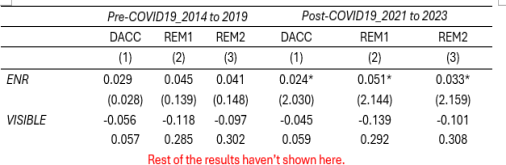
Figure 1: Multiple regression results on pre-and post-COVID-19
2025-05-22
Individual Report Using Data Analytics Tools