Econ 151B Winter 2018 Quiz 2
Hello, dear friend, you can consult us at any time if you have any questions, add WeChat: daixieit
Econ 151B
Winter 2018
Quiz 2
1) True/False Questions. Circle the appropriate letter (1 point each)
a) One reason that black workers’ wages increased relative to white workers’ wages during the 1960s and 1970s is that black workers were leaving the labor force.
T F
b) If employers discriminate because customers are prejudiced then employers are not maximizing their profits.
T F
c) According to the theory of statistical discrimination, the process of competition should put discriminating employers at a disadvantage.
T F
d) If black workers are discriminated against in the labor market because employers are prejudiced
against blacks then an increase in the supply of blacks will reduce their wage relative to whites.
T F
e) If men in occupation A earn $20/hr and women in occupation B earn $20/hr then there is no discrimination.
T F
f) Estimates of the degree of discrimination may be upwardly biased if certain variables that have a positive effect on productivity are not controlled.
T F
g) The Civil Rights Act of 1964 established quotas for hiring minority workers.
T F
h) Cases of disparate impact can be won if there is evidence of employment imbalances across
groups, even if there is no evidence that the employer is intending to discriminate.
T F
i) One piece of evidence that the convergence between black and white wages that occurred during the 1960s and early 1970s was driven by something other than a reduction in whites’ prejudice, is that wages converged the most in the South
T F
2) Compare and contrast the “taste for discrimination” model based on employer prejudice, and the statistical discrimination model. What are the implications of each in terms of the persistence of discrimination? What are the policy implications of each? (4pnts)
3) Suppose that there are two groups of potential workers: group Y and group Z. On average, members of group Y have higher skill levels than members of group Z. Employers give all potential employees an unbiased test in order to determine their skill level. The test provides a noisy assessment of an individual’s actual skill level, and the test is equally noisy for members of group Y and members of group Z.
Wages are determined using information on an individual’s test score (T), and using information on the average skill level (a) of the group to which the individual belongs.
The diagram below shows the relationship between wages and the test score for group Y. The dotted line is a 45 degree line.
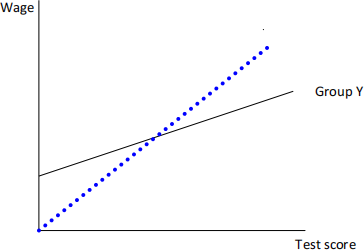
a) On the diagram above, draw the relationship between wages and the test score for group
Z relative to group Y. Make sure that you label the relationship for each group. (2 pnts)
b) Provide some intuition about why the two lines have the relationship to each other that
they have. Do the lines cross? Why or why not? Are the intercepts the same or different? Explain. (4 pnts)
5. Suppose years of schooling, S, is the only variable that affects earnings. The equations for the weekly salaries of male and female workers are given by
wm = 500 + 100S
wf = 300 + 100S
On average men have 13 years of schooling and women have 10 years of schooling.
a) What is the average male-female wage difference in this labor market? (2 pnts)
b) Is there discrimination in this labor market? Why or why not? (3 pnts)
4. In their paper “Are Emily and Greg More Employable than Lakisha and Jamal?” Bertrand and Mullainathan use an alternative audit strategy to estimate the level of discrimination encountered by blacks in the labor market. This method does not involve in person interviews, but is based on resumes only. (6 points)
1) In one or two sentences describe what Bertrand and Mullainathan do in their study (1 pnt)
2) What do they find? (1 pnt)
3) In what ways might their estimates be more accurate measures of discrimination than estimates based on an in person audit? (2 pts)
4) Why might their estimates be less accurate measures of discrimination than estimates based on an in person audit? (2 pnts)
2025-05-22
Human Resource Economics