Project Guidelines for NPB 102 Animal Behavior
Hello, dear friend, you can consult us at any time if you have any questions, add WeChat: daixieit
Project Guidelines for NPB 102 Animal Behavior
Project Goals:
• To observe, learn about, and analyze animal behavior using different parts of your brain and skill set.
“Imagination is more important than knowledge. For knowledge is limited to all we now know and understand, while imagination embraces the entire world, and all there ever will be to know and understand.” – Albert Einstein
• To practice and hone your skills in effectively communicating concepts of animal behavior and their importance to the scientific community and general public.
Importance of Practicing Effective Science Communication:
• The public needs to understand certain basics of science to make informed decisions (e.g. concerning health, environment, teaching curricula, scientific policy, etc.)
• Examples of when poor science communication has led to mistrust and misunderstanding by certain groups:
o Climate change (it doesn’t exist…)
o Vaccinations (will give you autism…)
o Evolution (never happened…)
o The use of animal models in research (scientists are evil bunny killers…)
o For more information concerning this logic, see:
▪ Brownell et al. 2013. Science communication to the general public: why we need to teach undergraduate and graduate students this skill as part of their formal scientific training.
12(1):E6-E10.
Is This a Group Project?
• Nope.
Video Project Assignment: Due May 13th by 11:59pm.
You are to create and narrate a 1½ to 2 minute video in which you film and describe a behavior(s) of interest of a local, wild animal/group of animals. Various birds, insects, reptiles, amphibians, squirrels - these are all easy to find locally. For a list of animals that live in Davis, go to Davis wiki (https://localwiki.org/davis/Town_Fauna). You can also check out the arboretum’s website (https://arboretum.ucdavis.edu/wildlife). Local wildlife hotspots in Davis include the arboretum, Northstar Park and surrounding greenbelt.
Though not required, you are welcome to supplement your own footage with other media sources, as long as the rights for downloading and using them fall under the creative commons license and/or are permissible for use in a school project. No matter what source you use, you MUST GIVE FULL CREDIT TO ITS CREATOR AND SOURCE OF DISTRIBUTION and any other information that accompanies it. To not do so is considered plagiarism, which will result in a zero grade (no exceptions).
Once you have filmed your animal, you will narrate the video demonstrating animal behavior concepts from the quarter. Thus, your video will take the form of a mini animal documentary (think Planet Earth, David Attenborough, BBC, etc.). You will also turn in an ethogram that represents your video. A full rubric for the evaluation of the project is included below.
Full project details:
1. Observe and video record a behavior(s) of a local, wild animal
o The animal of your choosing must be observed out in the wild in Davis, areas surrounding Davis, or any other place you visit between now and when your project is due.
 Note: you cannot use people, a domesticated animal (pet, livestock), or a zoo/captive animal.
 You don’t need to use a mammal or bird – insects, reptiles, amphibians, etc are all welcomed!
o Your final video must be between 1½ and 2 minutes in length, including the title and credit slides.
2. Develop an ethogram for the behavior(s) of interest you observe
o An ethogram is an inventory list and detailed description of behaviors.
 The descriptions should not contain any information beyond how to identify the behavior. Do not use the name of the behavior itself in its definition.
• For example, for feeding, the description should not say “feeding/eating”. Instead, what is the animal doing that allowed you to identify it as feeding behavior?
• The example ethogram below is a BAD example for this; do NOT follow their lead.
o Constrain your ethogram to only the behavior(s) witnessed for the 2 minutes of your video presentation.
o How to develop an ethogram:
 Early in the quarter, we will talk/talked about the importance of developing ethograms to describe, measure, and analyze behavior
• See pages 5-6 of your Nordell and Valone Animal Behavior text for an example.
• Use Table 1.1 on page 6 (also pictured below) as a recommended format for how to format your ethogram. The more details you give, the better!
• No need to differentiate between high and low frequency behaviors, but feel free to organize the ethogram as you see fit (for example, you might want to keep all the social behaviors one after another)
• Do NOT assume that a behavior you observe in the wild in a non-elephant is the same as the elephant’s behavior. For example, head bobbing in many species is not a stereotypic behavior, but instead part of communication, antipredator behavior, or something else.
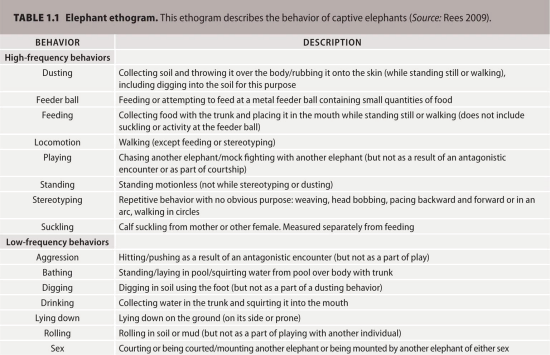
3. Narrate your video
o During your 1½ to 2 minute video, you will need to have captured enough behavior to be able to use your ethogram to narrate the behavior(s) the animal is/animals are engaging in. Your narration must demonstrate at least one of the key behavioral concepts we cover this quarter AND WHY IT IS
IMPORTANT FOR US TO UNDERSTAND.
o This last part is a vital, key aspect of science communication. The behavior doesn’t
necessarily need to relate to human behavior, of course, though sometimes people more easily identify with that. However, how the behavior helps us to learn more about the concept in general, the environment, the world we live in, etc. would be an important point to communicate as well.
o Your narration should not just name the behaviors the animal is engaging in. Rather use your
narration to tell a story about the animal’s behavior, based around the key behavioral concept (above) and primary literature. You can provide some “play by play” descriptions of what’s going on, but you should aim to teach the viewer WHY they are seeing what they are seeing.
4. Cite at least one scientific study from the primary literature
o During your narration, you must cite the findings of one scientific study from the primary literature that supports whatever you are trying to convey.
o You must cite your source(s) in 2 places: the narration itself and a credit slide (below)
o In your narration, you can state something like, “In a study conducted by (author’s last name, (if there are more than one authors, just state the first author’s last name and then state, “et
al”.) in the journal of (journal name), that ….(relevant finding here) …”
 Ex: “ In a study conducted by Nuñez et al. in the journal of Animal Behavior, authors reported that squirrels forage for food during this time of year in order to conserve resources during harsh climates.”
 This takes the place of an in text citation in a written paper.
5. Title and Credit slides
o Title slide (first slide)
o Create a title text slide at the beginning of your video in which you write out:
1) Your title (This should be in larger font compared to #2 and #3 below)
2) Your name
3) NPB 102 Animal Behavior (Spring 2025) Project, UC Davis
o Credit slide (last slide)
o Create a credits text slide at the end of your video in which you write out: - include only the bolded part here plus whatever you fill in.
 “This film has been narrated/directed/filmed (whatever you did here) by (your
name(s) here) as part of my/our project for Dr. Calisi-Rodriguez’s (“Ka-LEE-see Rod-REE-gis-iz”) NPB 102 Animal Behavior Spring 2025 course at UC Davis. I would like to thank (arkive.org/ BBC Natural History Unit and Sound Library (or whatever/whoever the source(s)/creators are for your downloaded video(s)/images you use)for the supplemental use of their (videos/images/etc.)
o Also include:
 Full citation(s) of primary literature mentioned
• Author last name, first initial., second author last name, first initial., (and so on). (Year published). Article title. Journal name, Volume number, page numbers.
o Ex: Nuñez, R. Brown, T., & Wallace, J. (2021). The dietary habits of urban squirrels. Journal of Animal Behavior, 150, 21-39.
 Make your life easier! Find your article through a google scholar search, and then click the cite button below the entry (with the little quotation marks). It will automatically show you the full citation. Copy and paste the APA version onto your credit slide.
o Note: Title and Credit slides are to be included in the 2 min max video length time.
6. Submit Your Video with Your Ethogram (****Due May 13, by 11:59 PM****)
o Upload your video to “Final project” on our NPB 102 Canvas page, under the Assignments folder.
o Submit your video as a Google Drive link. Make sure that you’ve set the sharing settings so that anyone with the link can view it.
o Guidelines to help support a high quality upload can be found here:
https://support.google.com/youtube/answer/4603579?hl=en
o Your video should not be more than 400 MB (if it is, that likely signals there’s a formatting problem somewhere).
o Send the link to a friend and ask them to open it on their computer to ensure that it works!
o You will enter your ethogram in the comments section as you submit your google drive link.
o Note: Your ethogram MUST be entered into the provided text box. Any attached documents will not be considered.
o Any fancy formatting will not be saved so format your ethogram like this to increase readability for the graders:
Behavior 1 – definition for behavior 1
Behavior 2 – definition for behavior 2
Behavior 3 – definition for behavior 3
Helpful Resources:
For free film-editing software and/or equipment, here are some options:
• iMovie: How to Use iMovie on iPhone:https://www.youtube.com/watch?v=eBI4_k9- u5Q
• iMovie: Tutorial for Beginners on Mac:
https://www.youtube.com/watch?v=QN7bv6Y2JRg
• Windows Movie Maker:https://www.youtube.com/watch?v=26gZYUx_90U
2025-05-14