LNGS7563 Assignment 2: Plotting your vowels
Hello, dear friend, you can consult us at any time if you have any questions, add WeChat: daixieit
LNGS7563
Assignment 2: Plotting your vowels
Instructions:
Your task is to run an experiment, and to present your findings as a report (max 500 words). In this experiment, you will produce an acoustic analysis of the vowels you produce when speaking English. First, record yourself saying the words in the list on page 3.
Next, measure the F1 & F2 of the vowel of each word and use those measurements to make a map of your vowel space. Based on the relative position of the vowels within your own vowel space, label each point with the appropriate IPA symbol. For example, based on the position of the red dot relative to the others in the space, we might assign it the label [o].
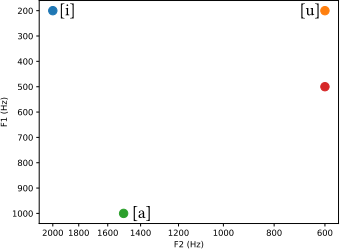
Figure 1: Example formant plot (arbitrary formant values used for demonstration)
If your word list includes diphthongs, please include them, making sure that each diphthong has a labeled start and end point, and a line connecting the two. For reasons of space, you may need to show them in a separate plot, but if so, make sure that the x and y axis scales and bounds are the same as those for your monophthong plot. Figure 2 gives you an example.
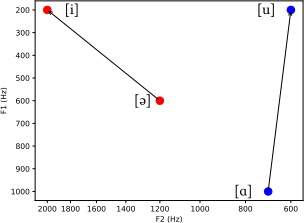
Figure 2: Example diphthong plot
Also provide a table showing the elicited word, chosen vowel symbol, and the average formant values. The table below gives you an example of how you could show this information, for both monophthongs and diphthongs (based off the made-up data used for Figures 1 and 2):
|
|
|
Start |
End |
||
|
Word |
Vowel |
F1 |
F2 |
F1 |
F2 |
|
heed |
[i] |
200 |
2000 |
- |
- |
|
... |
[ɑu] |
1000 |
900 |
200 |
600 |
|
... |
|
|
|
|
|
Finally, write brief report of your findings. In this report:
• describe any regional/cultural/social influences on the way you speak, being as specific as possible
• state how many phonemic contrasts there are in this set of vowels, noting any pairs of homophones
• comment on any results that you find surprising or otherwise interesting
Submission:
Please submit your plots, table, and report as a single PDF. You must also include your audio recording(s) as part of your submission on canvas.
Wordlist
heed
hid
head
had
hod
hud
hawed
hood
who’d
heard
hard
hoard
hoyed
hayed
hoed
how’d
hide
Tips:
• You are being marked on how well you can present your findings. Make sure your plots look good, everything is labeled, and that the information is visually accessible.
• Your vowels may not be the same as those that you learned for Australian English. Focus on what your own data show.
• You can take your own initiative on how you run this experiment, and show your findings. For example, you may wish to represent your vowels as clusters of values, rather than single points.
• So long as you have addressed all points, don’t worry if your word count is lower than 500. Please don’t exceed 500 words (excluding figures and tables).
• The data used for charts and tables in this document are completely made up, and should not be used as a guide for how to label your own vowels
2025-04-17