ABEE2032 Environmental Performance Modelling 2024/25 Autumn Semester Coursework
Hello, dear friend, you can consult us at any time if you have any questions, add WeChat: daixieit
Department of Architecture and Built Environment
ABEE2032 Environmental Performance Modelling
2024/25 Autumn Semester Coursework (21 Sep 2024 updated)
Introduction
Consider a 4-zone building located in Shanghai as illustrated in Figure 1. The building does not have any windows, doors, internal heat sources. There is no infiltration or air exchange. All walls are 20 cm bricks, roof is 20 cm concrete and the floor is insulated. Assume the room temperature is maintained at 25 oC, evaluate the cooling load in the summer design day (21st July) using both IES-VE and Matlab, and compare the results.
You can make the necessary assumption for the inputs of your model, and you will need to list them clearly in your report.
You will need to submit a report not exceeding 4000 words (5% penalty will be applied if over the word limit) . You may include pictures, diagrams, graphs or sketches in your report. These must, however, be linked to your text and used to help in your description of the building and its performance. Do not include any visual material that is not discussed in the text.
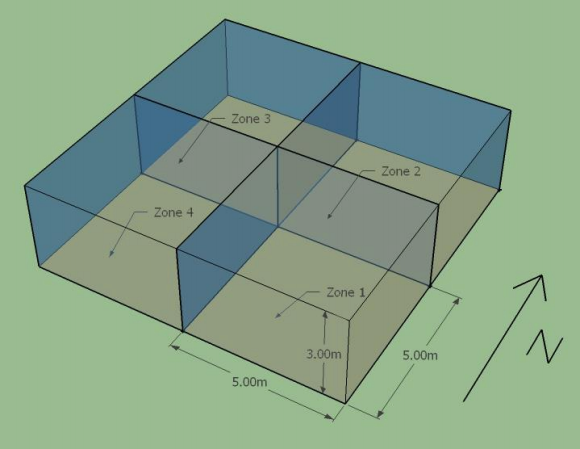
Figure 1 Sketch of the building
Tasks and weights
1. You should use IES-VE to develop a model and evaluate the cooling load in the summer design day. [20%]
2. You should use Matlab to calculate and plot the cooling load with time interval of 10 minutes in any one of the rooms in the summer design day (21st July). Assume the initial building temperature is 25 oC (Hard mode: You are encouraged to run a 10-day pre-conditioning for the previous day (20th July) in order to get the initial condition for the day of 21st July. You can assume the initial building temperature is 25 oC on 20th July. NOTE: students may get higher marks on this part by finishing the hard mode).
To obtain the cooling load, you should:
Derive a 5 node finite difference models for all walls and roof. Use appropriate time step ∆t so the Fourier Number Fo ≤ 0.5 .
Solve and plot convective transfer coefficient h for all exterior surfaces of walls and roofs, using either Simple-combined, TARP or McAdams algorithms.
Solve and plot h for all interior surfaces of walls and roofs, using either Walton model or Alamdari – Hammond model.
Calculate the solar radiation with either ASHRAE Clear Sky Model or Zhang-Huang Model. (Easy mode : student can choose to adopt the direct and diffuse solar radiation from weather data. NOTE: students may not get high marks on this part by choosing the easy mode)
Calculate the convective heat exchange between air and interior surfaces, assuming the temperature of internal walls is maintained at 25 oC and the interior long-wave radiation among internal surfaces is neglected. (Hard mode : Students can choose to calculate long-wave radiation among all interior surfaces and the temperatures of all interior surfaces. NOTE: students may get higher marks at this part by finishing the hard mode)
Calculate and plot cooling load using Heat Balance Method. [50%]
3. Compare the IES-VE results and Matlab results on the summer design day. Discuss what causes these differences. [20%]
*Presentation and clarity of the report.
Interim progress check
There will be three interim progress checks on 16th October, 6th November and 27th November 2024, respectively. Students will have to bring their ongoing work to the class and present the progress to the tutor individually.
Coursework Submission Deadline
You should submit your report on Moodle AND a compressed model folder (including IES- VE files and Matlab files) to me via emails no later than 4.00pm on Thursday 12th December 2024.
Suggested Report Structure
Title Page
• Title of the Report
• Student Name
• Student ID
• Course Name and Code : ABEE2032 Environmental Performance Modelling
• Department: Department of Architecture and Built Environment
• University: The University of Nottingham Ningbo China
• Date of Submission
Abstract (Approx. 200-300 words)
The abstract serves as a concise summary of your entire report, typically around 200-300 words. It should provide a clear and brief overview of the purpose, methods, key findings, and conclusions of your study.
1. Introduction (Approx. 300-500 words)
1.1 Background
1.2 Description of the Building
1.3 Objectives
2. Methodology (Approx. 1,000 words)
2.1 Assumptions and Input Parameters
2.2 IES-VE Modelling
2.3 MATLAB Modelling
3. Results (Approx. 1,500 words)
2.1 IES-VE Simulation Results
2.2 MATLAB Simulation Results
4. Discussion (Approx. 700 words)
4.1 Comparison of IES-VE and MATLAB Results
4.2 Analysis of Differences
5. Conclusion (Approx. 300 words)
The conclusion is a vital part of your report where you wrap up your study by summarising the key findings, reflecting on the objectives, discussing the implications, and offering recommendations.
References
Appendices (Optional)
Presentation and Clarity Tips
• Consistent Formatting
o Use consistent fonts, headings, and spacing throughout the report.
• Figure and Table Labels
o Number and title all figures and tables; reference them in the text.
• Equations
o Number equations and ensure they are clear and legible.
• Language and Style
o Write in clear, formal academic English.
• Proofreading
o Check for grammatical errors and typos.
• Word Limit
o Ensure the report does not exceed 4,000 words.
2024-12-03