MTH3241 Past Exam 2
Hello, dear friend, you can consult us at any time if you have any questions, add WeChat: daixieit
MTH3241
Past Exam 2
1 Customers arrive at a bank according to a Poisson process with rate λ. Let Xt be the number of customers who enter the bank by time t, and Yt be the number of customers who enter the bank by time t only to make deposits to their accounts. We refer to these customers (those who enter the bank only to make deposits) as D customers. Suppose, that independent of other customers, the probability is p that a customer is a D customer. All answers must be justified.
(a) What is the probability that no customer enters the bank between the times s and t (s < t)?
(b) What is the probability that m (m = 0, 1, 2, . . .) D customers enter the bank between the times s and t (s < t)?
(c) A customer has just entered the bank. What is the probability that a time longer than t elapses before the next customer enters the bank?
(d) A customer has just entered the bank. What is the probability that a time longer than t elapses before the next D customer enters the bank?
(e) What is the probability that exactly n customers arrive by time t given that exactly m (m ≤ n) customers arrive to the bank by time s (s < t)?
(f) What is the probability that exactly m customers arrive by time s given that exactly n (n ≥ m) customers arrive to the bank by time t (t > s)?
[12 marks]
2 The state of a computer network changes according to a 4-state discrete-time Markov chain with transition probability matrix
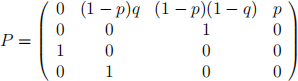
where 0 ≤ p ≤ 1, 0 < q < 1 and the states are labelled 1, 2, 3 and 4.
(a) Obtain a full classification of the states in this Markov chain (classes, re-currence, transience, periodicity), taking into account the possible values of p.
(b) Assume that p = 0. Obtain the steady-state probabilities of the recurrence class.
(c) Assume that p = 0 and X0 = 2. What is the long-term expected fraction of time that the chain is in state 1?
[12 marks]
3 A gambler repeatedly bets $1 on a game of chance where the probability of winning depends on the amount of money she has. If she has $i the probability of winning $1 is pi and the probability of losing $1 is qi = 1 − pi . She starts with $2 and decides to play until the total amount of money she has is $3 or she has no money left. Express all your answers in terms of p1 and p2.
(a) Write down the transition probability matrix of this Markov chain.
(b) What is the probability that she loses all her money?
(c) What is the expected number of games she will play?
[10 marks]
4 A house has 2 rooms of similar sizes with identical air conditioners equipped with thermostats which turn on and off as needed to maintain the temperature in each room to a desired level of 22◦ . Suppose that a thermostat remains on or off for exponential amounts of time with means 1/µ and 1/λ, respectively, independently of other thermostats.
(a) Consider the Markov process, {X(t), t ≥ 0}, whose state space is the number of active air conditioners. Write down the matrix of the transition rates, the transition probability matrix of the corresponding embedded Markov chain, as well as the transition rates out of each of the states.
(b) Let pij (t) = P(X(t) = j|X(0) = i). Show that

and deduce π0, the steady-state probability associated with state 0.
(c) Obtain all steady-state probabilities of this Markov chain.
[14 marks]
5 A population is modelled by a branching process, {Xn, n ≥ 0}, in which X0 = 1 and the offspring distribution is

(a) Find the mean and the variance of Xn, for any given n.
(b) Find the probability of the population dying out by the second generation.
(c) Find the probability of the population dying out on the second generation.
(d) Obtain the probability of ultimate extinction of the population.
[10 marks]
6 Consider a particle that moves according to a simple random walk. Denote by Xn the position of the particle immediately after step n. Assume that X0 = 0 and that, at each step, the position of the particle goes up (by one) with probability p and down (by one) with probability 1 − p.
(a) Obtain P(X2 > 4) and P(X4 > 2).
(b) Find the probability that the particle visits 0 twice in 4 steps; i.e. find P(X2 = 0, X4 = 0).
(c) Find the probability that the particle visits 0 for the first time after 4 steps.
[6 marks]
7 Let V1, V2, . . . be a sequence of independent and identically distributed random variables with
E[V1] = 1 and P(0 ≤ V1 ≤ K) = 1,
for some constant K. Define Mn as follows:
M0 = 1 and Mn = Mn−1Vn, for n ≥ 1.
(a) Show that Mn is a martingale with respect to the filtration {Fn, n = 0, 1, . . .} generated by the sequence V1, V2, . . ..
(b) Let 2 = var(V1). Show that  is a martingale with respect {Fn, n = 0, 1, . . .}.
(c) Assume that P(V1 = 0) = P(V1 = 2) = 1/2 and let T be the first time Mn reaches 0. Explain why we cannot use Doob’s Optional Stopping Theorem in this context – show that the assumptions are not met and that one would get a contradictory result.
[8 marks]
2024-07-18