COMP4500/COMP7500 Advanced Algorithms & Data Structures Semester Two Final Examinations, 2021
Hello, dear friend, you can consult us at any time if you have any questions, add WeChat: daixieit
Semester Two Final Examinations, 2021
COMP4500/COMP7500 Advanced Algorithms & Data Structures
Question 1 [8 marks]
Let f(n) e O(na ) and g (n) e O(nb ) for real constants a and b, and function h(n) bedefined as f(n)xg(n) for all n. Using the definition of O-notation, prove that the function h(n) e O(na+b ) for any real constants a and b. Show your working.
Question 2 [9 marks]
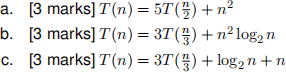
Solve the following recurrence equations to get a tight asymptotic bound on the complexity of the cor- responding functions. You do not need to show your working: in your answer you only need to give a tight asymptotic bound on the complexity of each function. You may assume that T(n) = Θ(1) for suitable constant n. (You may leave logarithmic expressions in your answers if they evaluate to nonintegral values.)
Question 3 [8 marks]
The breadth-first search procedure BFS, given below, assumes that the input graph G = (V, E) is repre- sented using an adjacency-list representation.
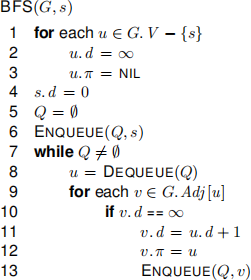
a. [4 marks] Modify the breadth-first search procedure to assume that the input graph is represented using an adjacency-matrix representation instead.
b. [4 marks] Assuming an efficient implementation of the queue (so that both enqueue and dequeue operations take constant time), and an input graph G with n vertices and m edges, describe the worst-case asymptotic time complexity of your procedure that assumes an adjacency-matrix repre- sentation of the graph, and how it compares to the worst-case asymptotic time complexity of the existing procedure that assumes an adjacency-list representation. Clearly justify your answer.
Question 4 [20 marks]
Recall that a path p from v1 to vn in a weighted graph G = (V, E) with weight function weight, is a sequence of vertices, hv1, v2, v3,...,vni, such that for i from 1 ton−1, (vi, vi+1) 2 G.E . The total weight of the path, weight(p), is the sum of the weights of edges along the way, weight(p) =P 1 weight(vi, vi+1). A shortest path from v1 to vn is a path from v1 to vn of minimum weight.
a. [10 marks] Given the following inputs:
(i) a directed weighted graph G = (V, E) without negative weight cycles, with edge weights weight
where, for (u, v) 2 G.E , weight(u, v) < 1 is the weight of the edge from u to v , (ii) vertices ustart and vfinish from G. V , and
(iii) a shortest path matrix, sp such that for any u, v 2 G. V , sp(u, v) gives the weight of a shortest path from vertex u to v, if there is one, or 1 otherwise,
write an efficient algorithm in pseudocode that calculates and returns a set of edges S such that (u, v) 2 S if and only if (u, v) is an edge on any shortest path from ustart to vfinish in graph G. Given that the graph G has x vertices and y edges, your algorithm should run in worst-case O(x + y) time.
b. [10 marks] Given (only) the following inputs:
(i) a directed weighted graph G = (V, E) with non-negative edge weights, with edge weights weight where, for (u, v) 2 G.E , 0  weight(u, v) < 1 is the weight of the edge from u to v, and
(ii) vertices ustart and vfinish from G. V ,
write an efficient algorithm in pseudocode that calculates and returns a set of edges S such that (u, v) 2 S if and only if (u, v) is an edge on any shortest path from ustart to vfinish in graph G.
Your algorithm may use algorithms studied in the course as subroutines.
Given that the graph G has x vertices and y edges, your algorithm should run in worst-case O(x2 ) time. You must clearly explain why your algorithm, if implemented efficiently, runs in O(x2 ) time. Explain which choices of data structures (also in any subroutines that you use) will result in the desiredefficiency.
Question 5 [25 marks]
A festival consists of an opening ceremony event (the 0th event), followed by a sequence of n further events, that take place one at a time, in sequential order.
There are m > 0 different venues, numbered from 1 tom, that can be used to host festival events. The venues are connected via a transport network that is described by a weighted directed graph G = (V, E), with vertices G. V representing each of the m different venues, with weight function weight, where for any venues u, v 2 G. V , weight(u, v) represents the cost of transporting festival participants directly from venue u to venue v. For any venue u 2 G. V we define weight(u, u) to be zero, and for any venues u, v 2 G. V , such that v  G. Adj[u] and v
  u, we defineweight(u, v) = 1.
The opening ceremony (the 0th event) must be hosted in venue number 1. Each of the remaining events in the ceremony needs to be hosted at one of the m possible festival venues. The i th event (for i 2 1, 2, ··· , n), can either be hosted at the venue that hosted the previous event, the (i − 1)th event, or at a venue which is adjacent in graph G to the venue that hosted the previous event. This is so that the festival participants can get directly from one event to the next.
The cost of hiring venue j for the i th event, for j 2 1, 2,... mandi 2 1, 2,...n, is given by hire[i][j].
Given a particular choice of venue for each event, the overall cost of hosting events 1 ton is defined to be the sum

where v0 = 1, the venue that the opening ceremony must be hosted at, and for i 2 1, 2,...n, vi is the venue chosen to host the i th event.
The problem is to find the minimum possible overall cost of hosting events 1 ton, for any choice of venues for events 1 ton. This problem can be solved by dynamic programming.
a. [15 marks] For integers i and j such that 1  i
i  n and 0
  j
j  m, let M(i, j) be the minimum
overall cost of hosting events i throughton, given that the venue chosen to host the (i − 1)thevent
was venue j. The solution we seek is M(1, 1).
Give a recurrence defining M(i, j) for 1  i
i  n, 1
n, 1  j
j  m.
m.
You do NOT have to give a dynamic programming solution, just the recurrence.
Be sure to define the base cases of the recurrence as well as the more general cases.
b. [10 marks] For the dynamic programming solution indicate in what order the elements of the table M corresponding to the recurrence should be calculated. As part of answering this question, give pseudocode indicating the evaluation order. Give both the time and space complexity of the dynamic programming solution (based on recurrence M) in terms of nand m. Briefly justify your answer.
Question 6 [20 marks]
This question involves performing an amortised analysis of a data structure that uses a linked list of integers called list, which is initialized to be empty when an instance of the data structure is created, and has two operations, INSERT (e) that takes an integer e as a parameter and appends it to the end of list:
INSERT (e)
1 list.ADD (e)
and an operation REMOVE (k), which takes an integer k as a parameter and removes the k first elements from list, removing all the elements from list if the list contains fewer thank elements. As well as removing elements from list, operation REMOVE (k) also creates and returns a linked list of integer products (where ⇥ is integer multiplication) that is dependent on the contents of list (see code for details):
REMOVE (k)
1 result = hi // initialize the result to be an empty linked list
2 while k > 0 and list.SIZE () > 0
3 e = list.REMOVEFIRST()
4 iterator = list.ITERATOR ()
5 while iterator.HASNEXT()
6 result.ADD (e ⇥ iterator.NEXT ())
7 k = k − 1
8 return result
It is assumed that linked lists have operators ADD , that appends the specified element to the end of the list; SIZE (), that returns the number of elements in the list; REMOVEFIRST(), that removes and returns the first element in the linked list; and ITERATOR (), that returns an iterator over the linked list. An iterator over a linked list can be used to traverse the list in the forward direction from the front of the list to the end of the list. It has operators HASNEXT(), that returns true if this list iterator has more elements when traversing the list in the forward direction; NEXT () that returns the next element in the list and advances the cursor position to the next element.
In the following analysis, measure the cost of the operations on the data structure in terms of the number of times that method ADD is called on any linked list. Using this measure of cost, the INSERT (e) operation has an actual cost of 1, and the REMOVE (k) operation has an actual cost which is the number of times that line 6 of that method (i.e. code result.ADD (e ⇥ iterator.NEXT ())) is executed.
a. [5 marks] Using the definition of cost described, what is the actual cost of operation REMOVE (k), given that the size of list in the data structure isn before the operation is called. Your answer should be a precise count in the form of a summation, not an order of magnitude.
b. [15 marks] Using the definition of cost described, use the potential method to prove that the worst-case cost of any sequence of m operations on the data structure (given that the data structure has been initialised immediately prior to performing the sequence of operations) is actually O(m2 ). As part of your answer you need to (i) define a potential function, Φ , on the data structure; (ii) calculate the amortised cost of the INSERT and REMOVE operations using the actual cost of the operations and the potential function; (iii) justify why the value of your potential function after any sequence of m operations, starting from a freshly initialised data structure, is bound below by the initial value of the potential function; (iv) use the amortised costs of the operations to prove that the worst-case cost of any sequence of m operations on the data structure is actually O(m2 ).
Question 7 [10 marks]
Below we describe two computer science problems.
The weighted-vertex cover problem
A vertex cover C of a directed graph G = (V, E) is a subset of the vertices of G such that if (u, v) 2 G. E then u 2 C or v 2 C (or both). Given an integer-valued vertex weight function wvertex that maps each vertex in G. V to a corresponding integer-valued weight, the vertex-weight of vertex cover C is the sum of the weights of the vertices in C , i.e. Pu=C wvertex(u).
Given a directed graph G = (V, E) with an integer-valued vertex weight function wvertex, and an integer k ≥ 0, the weighted-vertex cover decision problem is to decide if G contains a vertex cover of at most vertex-weight k.
The weighted-edge cover problem
Given a vertex cover C of a directed graph G = (V, E), and an integer-valued edge weight function wedge that maps each directed edge in G. E to a corresponding integer-valued weight, the edge-weight of vertex cover C is the sum

Given a directed graph G = (V, E) with an integer-valued edge weight function wedge, and an integer m ≥ 0, the weighted-edge cover decision problem is to decide if G contains a vertex cover of at most edge-weight m.
a. [5 marks] Assuming that the weighted-vertex cover problem is NP-hard, prove that the weighted- edge cover problem is also NP-hard.
b. [5 marks] Show that the weighted-edge cover problem is NP-complete and clearly state any assumptions that you make.
2023-11-02