ECON6001/6701 Microeconomic Analysis 1, S2 2021 Problem Set 5
Hello, dear friend, you can consult us at any time if you have any questions, add WeChat: daixieit
Problem Set 5
ECON6001/6701 Microeconomic Analysis 1, S2 2021
Q1. (Proof of the First Welfare Theorem) This question provides a proof of the above theorem while asking you to prove some intermediate steps. To begin, fix any p such that p . wi>0. Provide arguments for the following two steps.
1. Suppose x is an optimal choice of i. Then for any other consumption bundle x0 ,

2. Use local non-satiation to show that p . x = p:wi at the optimal bundle x.
Solution. Proof of (1): By local non-satiation, since x is chosen, p . x = p .wi.
By of contradiction, if it were the case that x0 >x and p . x0  p . x = p . wi, thenx0 is in the budget set, is strictly preferred to x, and yet the latter is chosen. This is a contradiction. Hence (1) must hold.
Proof of (2): Similarly, suppose x0  x but if, by way of contradiction p. x0 <p.x. Then for a sufficiently small ">0, there is exists an "¡ball (see Lec 1) Bε(x0) such that for all y 2 Bε(x0), we have p . y < p . x. By local non-satiation, there would exist some y 2 Bε(x0) such that y > x, again contradicting that x is chosen when a cheaper y is available.
The proof of the theorem follows easily from the above two steps. Let p* be a competitive equilibrium and x be the equilibrium allocation of agent i. Then by (2),

Now pick any x1 ; :::; xI such that
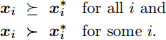
We will show such a sequence (which is unanimously weakly preferred to the competitive allocation) is not feasible for the economy. Then, by (1),
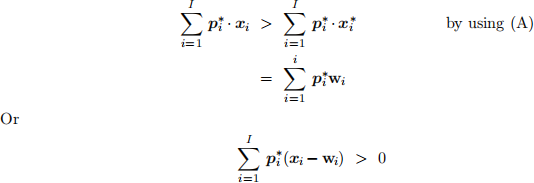
which means, x1 ; :::; xI is not a feasible allocation.
Q2. (Proof of Second Welfare Theorem.)
As above, this question leads to a proof of the Second Welfare Theorem while asking you to supply the intermediate steps as the exercise below. Suppose x1(*) ; :::; xI(*) is a Pareto Optimal allocation under assumption that a Competitive Equilibrium exists when wi = xi(*) for all i. Let p(^) be the corresponding equilibrium price.
Let x(^)1 ; :::; x(^)I be the corresponding allocation. If we show that x(^)i = x for all i, then we would have established the theorem. Toward this end,
a) Can agent i afford x at the prices p(^)?
b) Can agent i afford x(^)i at the prices p(^)?
c) How does p . x(^)i compare with p(^) . x ?
?
d) From the previous part, and using the fact that x 1(*); :::; xI(*) is Pareto Optimal, conclude that x(^)i  x
x for all i.
e) Now using strict convexity, conclude that x(^)i = x for all i.
Q3. Consider two agent, two-good (denoted by X and Y) endowment economy with following details
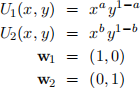
a) Calculate the competitive equilibrium and the equilibrium allocations. Is the equi- librium unique? (Hint: You know what the demand functions are for Cobb-Douglas utility functions. You should be able to do this relatively quickly.)
b) The endowment's are not all positive. And yet we have an equilibrium. Does this violate the equilibrium existence theorem?
Q4. Consider two agent, two-good (denoted by X and Y) endowment economy with following details: The indirect utility functions over prices p = (px; py) and income m and endowments are
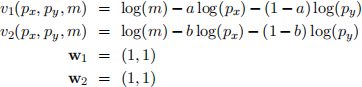
Calculate the competitive equilibrium and the corresponding allocations. Is the equilib- rium unique?
Q5 The following two questions appear on you Lec 5 slides
1) Draw an Edgeworth Diagram with convex prefrences but a Competitive Equilibrium does not exist. Hint: Give all of one good to one agent who cares only for that good.
2) Draw an Edgeworth Diagram with positive endowment of each good for each agent and yet a Competitive Equilibrium does not exist. Hint: Try non-convex preferences.
2023-09-04